
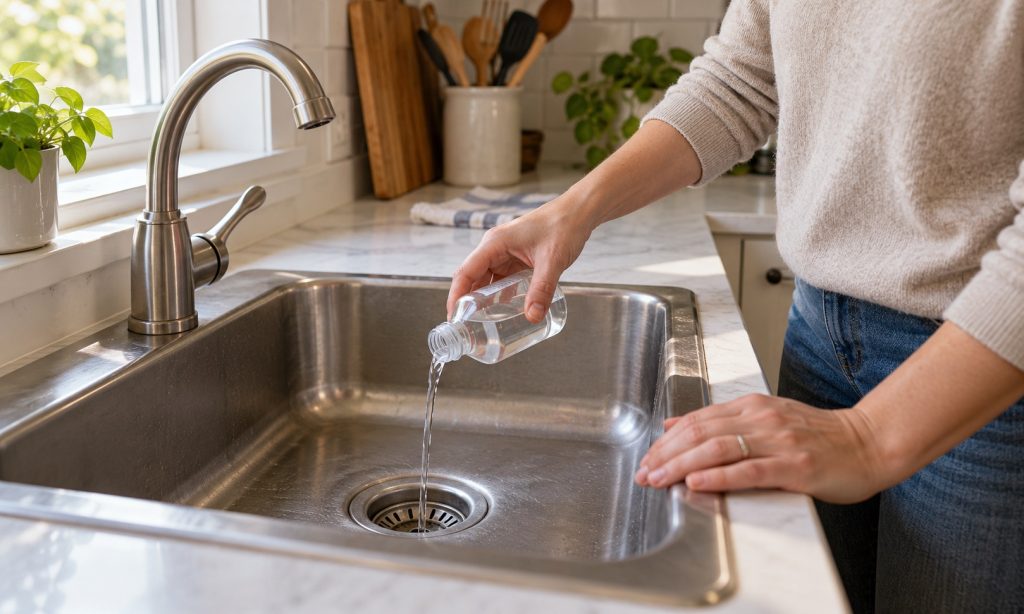
A slow sink or shower drain can turn an ordinary morning into a small plumbing investigation. Before reaching for a cleaner, it helps to know what the product is designed to do. How to use enzyme drain cleaner depends on the exact formula: some products are intended for routine maintenance, while others target mild organic buildup. Many are slow-acting, and some are not meant to open a completely blocked drain.
The safest starting point is the label. Check the directions, the fixtures it allows, the required wait time, and whether the product is suitable for your plumbing setup. Then decide whether the problem sounds like residue that may respond to gradual treatment or a physical blockage that needs to be removed.
What is an enzyme drain cleaner?
Enzyme drain cleaners use enzymes—and, in some formulas, bacteria—to act on certain organic materials inside pipes. Depending on the formula, these materials may include grease, food residue, soap buildup, or other debris. Enzymatic products work differently from drain openers that rely on corrosive chemicals to attack a clog.
That difference affects expectations. A maintenance formula may be designed to reduce buildup over time rather than clear a stopped drain quickly. For example, one product’s manufacturer describes its enzyme and bacteria formula as a preventive treatment and says it will not open clogs. That is why how to use enzyme drain cleaner cannot be answered with one universal dose or schedule.
The label also matters because “enzyme cleaner” does not describe one standardized recipe. Ingredients, uses, and directions vary. A formula suitable for a kitchen sink may not be approved for every toilet, garbage disposal, pipe material, or septic setup.
When should you use one?
An enzyme drain cleaner may be worth considering when water still drains, but it moves slowly, or when you are following a product’s maintenance directions. It may suit gradual treatment of compatible organic residue. The result is not necessarily immediate; the required contact time can range from hours to longer, depending on the product.
It is less likely to solve a drain that is fully blocked by a solid object, a large mass of hair, mineral deposits, tree roots, or a damaged pipe. A treatment that cannot reach the material—or is not designed for it—may simply sit in the line.
Before deciding how to use enzyme drain cleaner, look at the symptoms:
- One drain is a little slow: Check the stopper or drain screen for visible debris. If the product label matches the fixture and problem, follow its directions.
- Water is standing and not draining: A cleaner may not reach the obstruction. Consider an appropriate mechanical method or a plumber.
- Several fixtures are slow or backing up: The issue may be farther along in the drainage system. Stop using affected fixtures and seek professional advice.
- The clog keeps returning: Repeated treatments may hide the symptom without correcting its cause.
How to use enzyme drain cleaner, step by step
These steps offer a general approach. The product label takes priority because formulas and directions vary.
1. Identify the fixture and drainage problem
Note whether the issue is at a kitchen sink, bathroom sink, shower, tub, toilet, or another drain. Consider what may be entering it. Kitchen drains often collect food residue and grease; bathroom drains may collect hair and soap residue.
Check whether one fixture is affected or several. A problem confined to one drain may have a different cause from a backup affecting multiple parts of the home.
2. Read the whole label first
Before opening the container, confirm that the product is intended for the fixture and plumbing involved. Check its dosage, application method, contact time, flushing instructions, and any listed restrictions. Do not assume that a product safe for one kind of pipe is suitable for every drain or appliance.
If the product says it is for maintenance, do not treat that as a promise that it will clear a stopped drain. How to use enzyme drain cleaner correctly includes knowing when the product is not suited to the job.
3. Keep people and pets away during application
Follow the product’s handling instructions and protective-equipment advice. Pour carefully and close to the drain to reduce splashing. Keep the container closed and stored where children and pets cannot reach it.
Poison Control advises protective gear when using drain cleaners, including goggles and rubber gloves. Products vary, so follow the label even when a formula is described as enzyme-based.
4. Apply only the labeled amount
Measure the dose specified on the label. Do not add extra in the hope of speeding up the process. More product does not necessarily mean better results, and it may leave you with a different handling problem if the drain remains blocked.
For how to use enzyme drain cleaner in a slow sink or shower, apply the product exactly as directed. Some products call for treatment when the drain is not being used, while others have different procedures.
5. Give it the stated contact time
The cleaner needs the contact time on its label. Avoid running water, flushing, or using the fixture during that period if the directions say to let the product sit. Some formulas are intended to remain in the drain overnight; others specify another interval. Do not guess based on another product’s instructions.
This slower process may be inconvenient. Drain care is not usually the glamorous chapter of homeownership, but the label is still the most useful page in it.
6. Flush or repeat only as directed
When the contact time ends, follow the label’s instructions for flushing or rinsing. Use the stated water temperature and amount. Repeat a treatment only if the directions allow it, and only at the stated interval.
If the drain becomes fully blocked, the cleaner does not work after the labeled treatment, or the problem returns quickly, stop adding product. Reassess the cause instead of continuing to pour.
What if the drain is fully clogged?
A fully stopped drain is different from a slow one. If water cannot move, a gradual biological cleaner may not reach the blockage effectively. How to use enzyme drain cleaner in this situation may be “don’t use it as your only plan”—especially if the label describes a maintenance product rather than a clog opener.
For a simple, localized clog, a suitable plunger or drain snake may help remove the blockage mechanically. EPA guidance for homes with septic systems recommends avoiding chemical drain openers for clogged drains and using options such as a drain snake.
Avoid taking apart plumbing or using tools if you are unsure how to prevent a leak or safely manage standing water. If a cleaner has already been added, tell a plumber exactly what was used and when. Do not combine it with another drain product.
Safety: don’t mix cleaners
Never mix an enzyme drain cleaner with bleach, another drain cleaner, disinfectant, or a household cleaning product unless the label specifically directs you to do so. Different formulas can react with one another, and some combinations can release dangerous fumes. Poison Control’s general cleaning advice is clear: do not mix cleaning chemicals.
If you have used a different cleaner recently, check both labels for compatibility and instructions before adding anything else. If directions are unclear, contact the manufacturer or a plumbing professional. Keep the product in its original container, follow its storage directions, and avoid transferring it to a bottle that could be mistaken for a beverage.
Enzyme cleaners and septic systems
Septic guidance deserves special care. A product label may claim compatibility with a septic system, but EPA does not recommend septic tank additives as necessary for normal household wastewater treatment. EPA says additives may be ineffective or harm system operation and the environment.
EPA also advises against chemical drain openers for clogged drains in septic homes. If you have a septic system, check the product label and follow EPA and local guidance. For an ongoing septic or drainage problem, contact a qualified septic professional rather than relying on repeated treatments.
Preventing slow drains
A few habits can reduce the material reaching your pipes:
- Use a drain screen in sinks and showers where appropriate, and remove collected debris regularly.
- Put cooking grease and oil in the trash after they cool instead of pouring them down the kitchen sink. EPA specifically advises against sending grease down household drains.
- Scrape food scraps into the trash or compost rather than rinsing large amounts into the drain.
- Use a suitable hair catcher in the shower and clean it often.
- Follow maintenance directions only at the frequency stated on the product label.
- Pay attention to recurring slowdowns, gurgling, or odors instead of treating them indefinitely.
These steps will not prevent every clog. They can, however, help you notice a developing problem before a sink becomes a basin of regret.
Frequently asked questions
How long does enzyme drain cleaner take to work?
There is no single wait time. It depends on the formula and its label. Some products are designed to sit for several hours or overnight; others specify a different period. Follow the instructions for the product you have.
Can enzyme drain cleaner open a completely clogged drain?
Sometimes a product’s label may allow use for certain clogs, but many enzyme or bacteria formulas are intended for buildup prevention or slow drains and do not open full blockages. Check the product’s stated purpose. A solid obstruction, root intrusion, or damaged pipe needs a different solution.
Should I use hot or cold water afterward?
Use the water temperature listed on the label. One product’s directions do not apply to another. If the label does not clearly explain flushing, check its official instructions before proceeding.
Can I use enzyme cleaner in a toilet?
Only if the specific label says it is suitable for toilets. A product intended for a sink or shower should not automatically be used in a toilet. If the toilet is fully clogged, use an appropriate toilet plunger or contact a plumber.
Is an enzyme drain cleaner safe for every kind of pipe?
Do not assume so. Verify compatibility on the label for the pipe and fixture you have, especially if your plumbing is older or you are unsure of its material.
How often should I use it?
Use it only at the interval and amount stated on the label. Some maintenance products specify regular use; others do not. How to use enzyme drain cleaner includes following that schedule rather than treating every drain routinely without checking the directions.
What should I do if the drain is still slow?
Do not keep adding product beyond the label’s directions. Remove only accessible debris if you can do so safely. If the drain remains slow, the clog returns, several fixtures are affected, or you notice a backup, contact a plumber.
Final words
How to use enzyme drain cleaner comes down to matching the product to the drain, reading the label, applying the stated amount, and allowing the stated contact time. These cleaners may suit gradual treatment of certain organic buildup, but they are not a fix for every blockage or pipe problem.
If water is standing, multiple fixtures are affected, or the same drain keeps slowing down, focus on finding the cause. A suitable mechanical method or professional diagnosis may be the next step.
Sources
- U.S. Environmental Protection Agency, How to Care for Your Septic System and Frequent Questions on Septic Systems
- Poison Control, What’s in Drain Cleaner and What Happens if You Drink It? and Top Tips for a Safe Spring Cleaning