
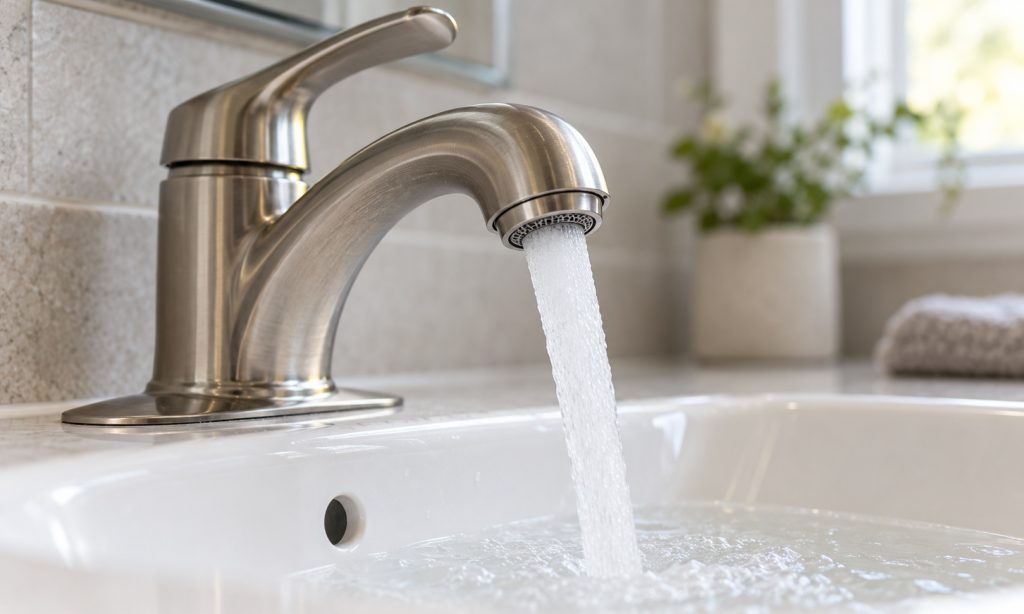
A faucet that splashes onto the counter, sends water out in an uneven spray, or seems to take forever to fill a pot can make a small fixture feel like a daily nuisance. The aerator at the end of the spout may be part of the reason. Understanding the types of faucet aerators helps you figure out whether you need a different water pattern, a replacement insert, or simply a good cleaning.
A faucet aerator is a small fitting at the spout outlet. Depending on its design, it can shape the stream, limit or regulate flow, and mix air into the water. That means two aerators that look similar can feel quite different in use.
One detail causes confusion: types of faucet aerators can refer to their water pattern, how they attach to the faucet, or both. This guide explains those categories separately, so you can compare options and check compatibility before replacing one.
What a faucet aerator does
Inside an aerator, small passages and screens direct the water as it exits the faucet. Some designs introduce air into the stream. Others form clear, parallel strands of water or a spray pattern. Many also control the faucet’s flow rate.
Adding air can make a stream appear fuller and feel softer without increasing the volume of water coming through the faucet. Flow control is a separate function: some aerators restrict flow, while pressure-compensating designs adjust to changes in water pressure. The EPA describes aerators, laminar-flow devices, and other flow controls as different kinds of faucet accessories.
That distinction matters when you compare the types of faucet aerators. A stream can feel broad or powerful without using as much water as its appearance suggests. Conversely, a low-flow model may not feel comfortable if its pattern does not suit your sink or water pressure.
Types of faucet aerators by stream pattern
The stream pattern affects how water feels at your hands, how it lands in the basin, and what tasks it suits. These are the main types of faucet aerators classified by the water they produce.
Aerated-stream aerators
An aerated aerator mixes air into the water. The result is usually a soft, white-looking stream that feels fuller than a clear stream. This is a common choice for residential bathroom and kitchen faucets.
For handwashing, the gentle feel can be comfortable. In a kitchen, an aerated stream may work well for everyday rinsing. Its main limitation is that it introduces air into the flow, so it may not be the best fit when you specifically want a clear, non-aerated stream.
Laminar-flow aerators
A laminar-flow device sends water through narrow passages to create smooth, distinct strands. The stream looks clear because air is not mixed into it. The EPA describes laminar devices as producing parallel streams that can create a more uniform flow and may reduce splash.
This pattern can be useful where a clear stream is preferred. However, “laminar” does not automatically mean a fixture is more hygienic or right for every household. Suitability depends on the faucet, setting, and applicable requirements.
Spray aerators
A spray aerator divides the water into multiple small streams, much like a miniature shower. The EPA notes that spray aerators can provide broad hand coverage, including at low flow rates.
That wide coverage can be useful for handwashing, especially in public or frequently used restrooms. On a home sink, whether the spray feels comfortable depends on the sink basin and the distance between the spout and drain. A pattern that spreads too widely can feel messy on a shallow sink.
Rain-spray aerators
A rain-spray design produces a wider, softer spray than a concentrated stream. It can cover more of your hands, but the larger pattern may not suit every basin or task. Think about where the water will land: a small sink can turn a broad spray into a splash problem.
Multi-stream aerators
A multi-stream aerator lets you switch between two patterns, such as a standard stream and a spray. Some dual-mode designs can also offer different flow settings.
This can be convenient if you want a gentler pattern for handwashing and a different one for rinsing. Before choosing one, check whether the design fits your specific faucet. Many pull-down and pull-out kitchen faucets switch patterns at the spray head, so their built-in sprayer is a different setup from a screw-on spout aerator.
Types of faucet aerators by mounting and construction
The stream pattern is only one part of the decision. The aerator must also attach to your faucet. These types of faucet aerators describe how the fitting is mounted or built.
Standard or exposed aerators
A standard aerator sits in a visible housing at the spout tip. Some have external threads; others have internal threads. The housing may turn by hand or require a tool, depending on the design.
Exposed aerators are usually easy to spot. But appearance alone will not confirm the thread size or whether the part will fit. A replacement needs to match the faucet’s fitting as well as the intended flow and stream pattern.
Hidden or cache aerators
A hidden, recessed, or “cache” aerator sits inside the faucet spout, leaving a smoother-looking tip. It may require a special key or another manufacturer-specific removal method. Moen, for example, documents several concealed-aerator designs and notes that their removal methods vary. Moen Solutions
Do not assume that a generic tool or replacement will fit. Check the faucet’s manual, model information, or manufacturer’s instructions before trying to remove a recessed aerator.
Swivel or ball-joint aerators
A swivel aerator pivots so you can direct the stream. This can help with a sink that is wide relative to the spout, or when you want to rinse different areas of the basin.
Its usefulness depends on the faucet’s clearance and the swivel’s range of motion. It also still has to match the spout connection, so “swivel” describes movement rather than universal compatibility.
Integrated and specialty designs
Some faucets use a built-in aerator, unusual outlet shape, or proprietary insert. In these cases, the aerator may not look like a separate, round part at the end of the spout. A model-specific replacement may be necessary.
This is another reason the types of faucet aerators should not be treated as a single list of interchangeable parts: stream pattern and mounting style are separate features, and manufacturers may combine them in different ways.
Flow rate: what the number means
An aerator’s flow rate is usually stated in gallons per minute (GPM). A lower number means less water flows through the fixture under the specified test conditions. The actual flow you experience can vary with water pressure and the faucet itself.
For private bathroom sink faucets and accessories, the EPA WaterSense specification sets a maximum flow rate of 1.5 GPM at 60 psi and a minimum of 0.8 GPM at 20 psi. EPA says the minimum helps maintain performance in homes with low water pressure. These figures apply to the bathroom-sink specification; they should not be assumed to govern every kitchen faucet or every location.
EPA also states that WaterSense-labeled bathroom faucets and aerators are independently certified against efficiency and performance criteria. Its current bathroom faucet page says the agency paused work on proposed specification revisions in February 2025, so a proposed change should not be mistaken for a finalized requirement.
When comparing the types of faucet aerators, consider the task, the faucet’s rated flow, your local requirements, and whether a slower fill would bother you. A bathroom sink and a kitchen sink do not necessarily need the same setup. For a kitchen, think about how often you fill pots or rinse produce; for a bathroom, consider handwashing and everyday sink use.
How to choose a compatible replacement
Before buying or installing an aerator, gather a little information about the faucet.
- Identify the faucet and its outlet. Look for the faucet brand and model, if available. Check whether the outlet has a visible threaded housing, a recessed insert, or a built-in design.
- Find the removal instructions. Faucets may use a screw-on aerator, a recessed aerator requiring a key, or another fitting. Gerber, for example, documents screw-on, wrench-operated, and coin-slot styles.
- Match the fitting. Check the manufacturer’s parts guide or take the removed insert to a plumbing-supply professional. Thread size, thread direction, housing diameter, and shape all matter. Do not buy based on appearance alone.
- Choose the stream pattern. An aerated stream is a common household option. Laminar, spray, rain-spray, and multi-stream designs serve different preferences and uses. Picture how the stream will meet the basin; a pattern that splashes around a shallow sink will get old quickly.
- Check the flow rate. Match the replacement to the faucet’s intended use and applicable requirements. A much lower rate may frustrate you when filling a container, while a higher rate may use more water than you want.
- Keep the seal and parts in order. If you remove the existing aerator, note how the pieces are arranged. Reinstall the sealing washer in the correct position, and avoid overtightening. Follow the faucet maker’s instructions.
The most useful rule for types of faucet aerators is simple: confirm fit first, then choose the flow and pattern that suit the sink.
Cleaning and troubleshooting
Mineral deposits or debris can partially block an aerator and distort the stream. A clogged aerator may cause weak flow or uneven spray. Moen recommends cleaning when debris or mineral buildup restricts flow or changes the spray pattern.
If the aerator is removable, follow the faucet manufacturer’s directions. Rinse away loose particles, inspect the screens and washer, and avoid sharp tools that could damage small parts. For stubborn mineral buildup, check the manufacturer’s cleaning guidance before soaking components.
If flow remains weak after cleaning, the aerator may not be the only cause. Check whether the problem affects hot water, cold water, or both, and consult the faucet manual. A cartridge, supply line, shutoff valve, or another part of the plumbing may also be involved.
Frequently asked questions
Are all faucet aerators interchangeable?
No. Aerators can differ in thread, diameter, shape, removal method, flow rate, and stream pattern. Hidden or proprietary designs may need a model-specific part.
Does a lower-flow aerator always save water?
A lower stated flow rate limits the water delivered under the test conditions. How useful that is depends on the faucet, the task, and whether the flow still works for you. Check the rated flow and applicable efficiency guidance before making a change.
Which type of faucet aerator is best for a kitchen sink?
There is no single best option for every kitchen. Consider what you do most often, the basin depth, the faucet’s outlet design, and whether you prefer a soft aerated stream or a different pattern. If the faucet has a pull-down or pull-out spray head, check its instructions before looking for a separate aerator.
Why does my faucet splash after I replace the aerator?
The new pattern may spread wider, or the outlet may sit too high or too close to the basin for that stream. Check that the aerator is installed correctly and matches the faucet. If the splash continues, a different compatible stream pattern may suit the sink better.
How do I know whether my aerator is hidden?
A recessed aerator sits inside the spout tip rather than in an obvious external ring. Some require a special removal key. Use the faucet manual or manufacturer’s parts information to identify the fitting before attempting removal.
Final words
The types of faucet aerators differ in two main ways: the water pattern they create and the way they fit the faucet. Aerated, laminar, spray, rain-spray, and multi-stream designs affect how the water feels and lands. Standard, hidden, swivel, and specialty designs describe how the part is mounted or constructed.
Before replacing one, confirm the faucet’s fitting, check the flow rate, and choose a pattern that works with your sink. A little checking upfront can save you from a replacement that looks right but will not fit—or a stream that turns handwashing into counter cleanup.
Sources
- U.S. Environmental Protection Agency, Bathroom Faucets. US EPA
- U.S. Environmental Protection Agency, WaterSense at Work: Faucets. epa.gov
- NEOPERL, Faucet aerators. neoperl.com
- Moen, Faucet Aerator Cleaning. Moen Solutions
- Gerber, How Do I Install or Remove An Aerator?.