
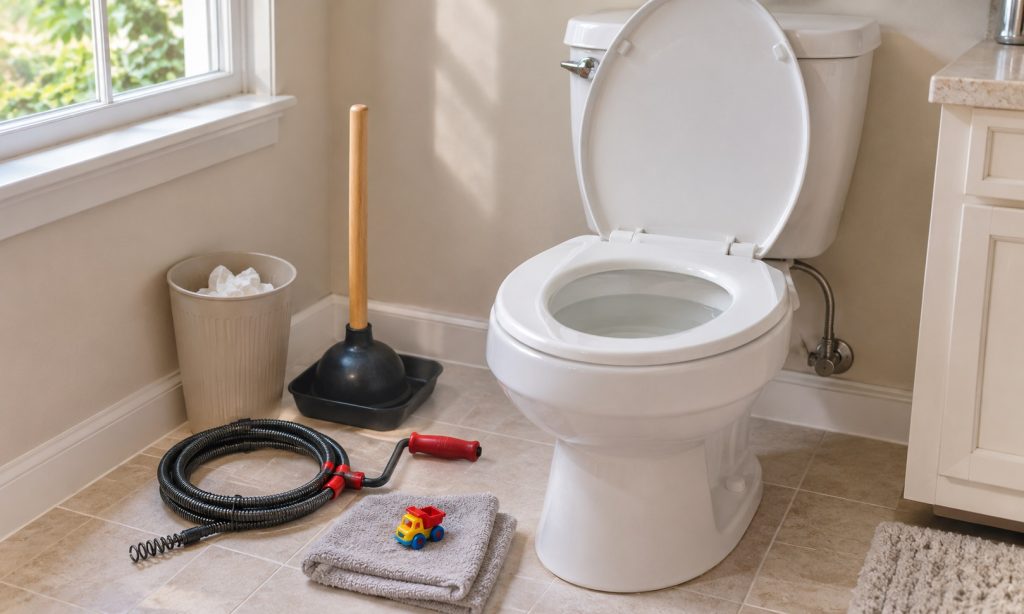
The bowl starts filling instead of draining. Maybe someone flushed cleaning wipes, or a small toy disappeared just before the problem began. Your first instinct might be to flush again. Leave the handle alone.
Knowing what to do if a toilet is clogged with wipes or an object starts with preventing an overflow. Stop flushing, shut off the toilet’s water supply if necessary, and identify what went down. Retrieve a visible, safely reachable item before trying to move a blockage with pressure.
Wipes and hard objects deserve different approaches. A soft blockage may respond to careful plunging; a lodged toy may need removal. Neither becomes harmless simply because the water eventually drains.
What to Do If a Toilet Is Clogged With Wipes or an Object: First Steps
Protect the room before working on the clog. Keep children and pets outside, clear nearby rugs, and put on waterproof gloves and eye protection.
Stop additional water from entering
Find the supply valve near the wall or floor behind the toilet. Close a round handle gently clockwise; operate a quarter-turn handle according to its design. Do not force a corroded or stuck valve.
Closing this valve stops the supply, but water already in the tank can still enter the bowl. On a conventional gravity toilet with an accessible flapper, carefully remove the tank lid and close the flapper if it remains open. Set the heavy lid somewhere secure. Do not dismantle unfamiliar pressure-assisted or concealed mechanisms.
If wastewater rises while nobody is flushing, a supply shutoff will not stop a drain backup. Stop using household plumbing and arrange urgent help.
Make space without adding more water
Do not plunge a bowl filled close to the rim. If no drain chemicals have been added, carefully transfer excess water into a stable, dedicated bucket using a disposable container. Avoid splashing and keep that bucket inaccessible to children and pets.
Do not pour contaminated water into a storm drain or yard. If chemicals are present, leave the bowl alone and tell the plumber exactly what was added.
Identify Wipes, a Hard Object, or a Wider Drain Problem
Choosing what to do if a toilet is clogged with wipes or an object depends on the likely obstruction. Ask everyone in the household what happened before the first slow flush.
| What you notice | What it may mean | Sensible next step |
|---|---|---|
| Wipes went down immediately before the clog | A wipe bundle may be caught locally | Retrieve visible material; consider controlled plunging if no hard object is suspected |
| A toy, cap, or brush part disappeared | A rigid item may be lodged in the trapway | Favor retrieval; avoid forcing it farther down |
| Water drains slowly, then the next use clogs again | A partial obstruction may remain | Stop repeated flushing and arrange inspection |
| Toilet trouble accompanies tub or floor-drain backup | The blockage may extend beyond the toilet | Stop water use and call for professional help |
These are clues, not a diagnosis. Poor flushing can also involve venting or other toilet faults.
Imagine a small plastic cap caught across the passage. Water might slip around it while toilet paper collects against it. That explains why one apparently successful flush does not necessarily prove a missing object is gone.
Why Wipes Can Cause Persistent Toilet Clogs
Toilet paper is designed for disposal through the toilet. Wipes can remain intact and accumulate in pipes. Municipal wastewater guidance warns that even wipes labeled “flushable” can contribute to blockages. [1]
The important point is not whether a wipe disappears from sight. It is whether the material travels through the whole drainage system without collecting somewhere else. The toilet is an impressive convenience, but a disappointing trash compactor.
When deciding what to do if a toilet is clogged with wipes or an object, do not rely on soaking overnight. Wipes may remain troublesome, and a plastic object will not turn into something drain-friendly while you sleep.
Retrieve a Visible Object Before Using Pressure
If the item is clearly visible and easily reachable, removing it is preferable to pushing it through the trapway.
With the water supply controlled and no chemicals present, use a waterproof-gloved hand to lift out a nonsharp object you can grasp safely. Pull gently toward the bowl. Stop if it resists or requires reaching beyond what you can see.
Do not reach blindly for broken glass, needles, sharp metal, or an unidentified item. Do not use a wire hanger to fish around the porcelain bends. Improvised tools can scratch the surface, lose their grip, or push the object deeper.
For a missing toy that is already out of reach, knowing what to do if a toilet is clogged with wipes or an object includes recognizing when retrieval needs professional access. More force is not automatically more progress.
Use a Flange Plunger for a Suspected Soft Blockage
Consider plunging when wipes or other soft material are suspected, no hard item is known to be present, and the bowl contains no drain chemicals. Skip this step when the aim is to recover a lodged solid object.
Establish a seal and work carefully
Use a toilet plunger with an extended flange that fits into the bowl outlet. Keep enough water to cover the cup, with ample space below the rim.
- Lower the cup at an angle to release trapped air.
- Seat the flange over the outlet.
- Start with a gentle push to limit splashing.
- Make a short series of controlled push-and-pull strokes while maintaining the seal.
- Lift the plunger carefully and observe whether the water drains.
If there is no improvement after a few short attempts, stop. Aggressive, prolonged plunging is not a reliable way to retrieve wipes or locate an obstruction.
If wipes come back into the bowl, remove and bag them. Do not flush them again. When considering what to do if a toilet is clogged with wipes or an object, remember that restored flow and confirmed removal are different outcomes.
Consider a Manual Toilet Auger Carefully
A toilet auger is designed to negotiate the toilet’s curved passage. Use one only if you understand its instructions and the situation remains suitable for a limited DIY attempt.
A guarded toilet tool helps protect porcelain, but careless handling can still cause damage. A general exposed drain cable is not an interchangeable substitute.
Follow the specific manual: retract the cable into its guide, seat the protected guide correctly, and advance it gradually using the prescribed cranking direction. Withdraw it as instructed, checking for retrieved material. Do not add drill power simply because progress feels slow.
Stop if the cable binds, stops rotating, or meets firm resistance. Resistance can come from a bend as well as an obstruction; it does not prove you have found the clog. Never keep twisting a stuck cable.
For a known hard object, ask a plumber about retrieval rather than trying to drive through it. An auger can sometimes restore flow without removing the item causing the trouble.
Avoid Chemicals and Unreliable Home Remedies
Online suggestions about what to do if a toilet is clogged with wipes or an object often treat every blockage like ordinary toilet paper. That misses the problem.
Do not add chemical drain opener
Caustic drain cleaners can cause severe burns. Leaving them in a blocked bowl creates additional risk for anyone retrieving material, plunging, or servicing the toilet. [2]
If a cleaner is already present, stop mechanical attempts, keep others away, and contact a plumber with the container information. Never add another cleaner or attempt to neutralize the first one. Follow poison-control guidance promptly if exposure occurs.
Skip boiling water and fizzing mixtures
Do not pour boiling water into the bowl; sudden heat can damage porcelain. Dish soap, vinegar, and baking soda are not dependable ways to remove a rigid object or a bundle of wipes.
Adding liquid also reduces the space available before an overflow. A fizzing bowl is not evidence that the obstruction has dissolved.
Know When a Plumber Should Take Over
The safest answer to what to do if a toilet is clogged with wipes or an object is sometimes to stop early. Call a plumber when:
- A known solid object is beyond safe reach.
- Controlled plunging or a cautious auger attempt fails.
- The toilet repeatedly blocks after temporarily improving.
- An auger becomes stuck or the porcelain appears damaged.
- Other drains back up, or sewage enters the room.
- You cannot control the water supply safely.
A plumber may need to lift the toilet to inspect its underside and outlet. Reinstallation involves a suitable new seal, correct positioning, and leak checks. It is not simply a matter of lifting the bowl and putting it back.
For a wider backup, professional investigation is appropriate; municipal guidance also recommends calling a plumber to establish the cause. [3] In a rental, notify maintenance before removing fixtures. Tell them what was flushed, which drains are affected, and what you have already tried.
Check Drainage and Clean Up Afterward
Once the obstruction has been retrieved or the blockage appears cleared, avoid an immediate series of flushes. A low water level alone does not prove the passage is clear.
If no hard object remains unaccounted for and no chemical hazard exists, cautiously add a small amount of room-temperature water while watching the level. Stop if it rises and does not recede. This checks basic drainage only; it does not reproduce a normal flush.
If drainage looks normal, restore the supply and perform one supervised flush without extra paper. Stay nearby to stop further tank discharge if necessary. Recurring slow drainage calls for inspection, not more testing.
Clean contaminated hard surfaces, then disinfect with a suitable labeled product, following its contact time and ventilation directions. Never mix cleaning chemicals. Wash hands thoroughly, clean the tools, and seek professional cleanup for extensive sewage contamination. [3]
Prevent Another Wipe or Object Blockage
Put a lined wastebasket within easy reach of the toilet. Keep spare wipes, small toiletries, and toys away from the tank lid and nearby shelves. Close the toilet lid when it is not in use.
FYI, placing the trash can across the room makes the wrong disposal choice more tempting. Make the correct one convenient.
Teach children to tell an adult immediately if something falls in. A visible item is usually easier to address before anybody flushes.
For septic homes, follow the same basic disposal rule: only human waste and toilet paper belong in the toilet. EPA guidance also advises avoiding chemical drain openers for clogged drains. [4] A septic system does not make wipes safer to flush.
Frequently Asked Questions
These answers cover common uncertainties about what to do if a toilet is clogged with wipes or an object.
Will a toilet clogged with wipes clear itself?
It might drain temporarily, but that does not confirm removal. Do not rely on wipes breaking down quickly or assume that waiting overnight solves the problem. Investigate persistent or recurring symptoms.
What if a toy was flushed but the toilet still works?
Avoid additional test flushes. A toy can remain lodged while allowing water past. Explain what disappeared to a plumber, particularly if it was rigid, relatively large, or followed by changed flushing behavior.
Can I use the shower while the toilet is clogged?
An isolated toilet clog does not necessarily affect other fixtures. However, if you notice gurgling, multiple slow drains, or wastewater coming up elsewhere, stop household water use until the cause is assessed.
Does a blocked toilet need replacement?
Not automatically. Removing the obstruction may restore operation. Replacement becomes a separate decision if the porcelain is cracked, an object cannot be removed safely, or inspection identifies another serious fixture problem.
Final Words
Understanding what to do if a toilet is clogged with wipes or an object means matching the response to the obstruction. Stop flushing, prevent overflow, and retrieve visible material safely. Try controlled plunging only when a soft blockage is likely, and use an auger within its instructions and your ability. For lodged objects, repeated clogs, or wider backups, arrange professional help before further attempts create more trouble.
References
These public-service resources support the disposal, chemical-safety, septic-care, and cleanup guidance above.