
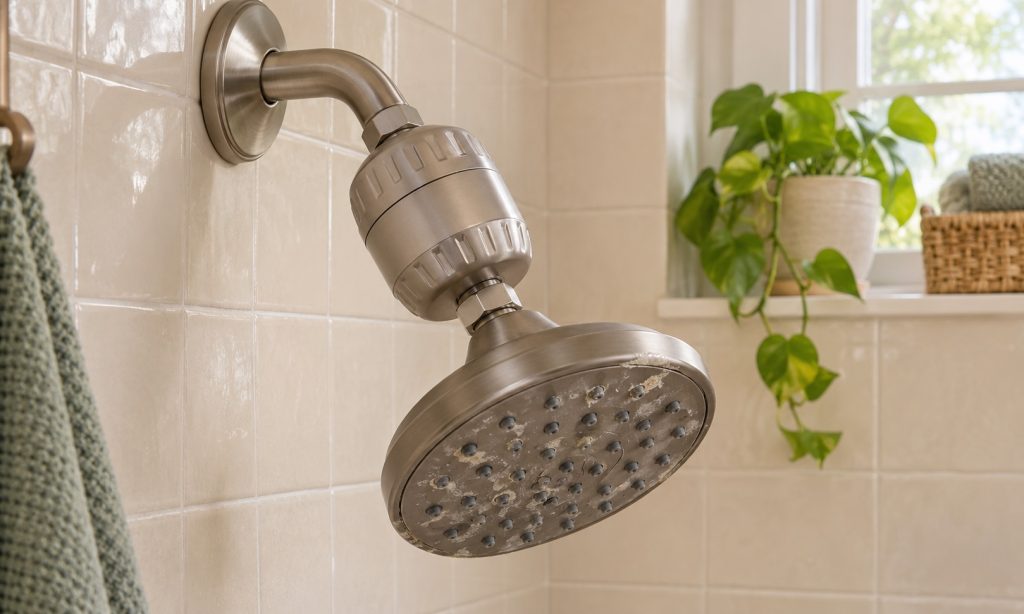
You wipe a white ring off the shower handle on Sunday. By Friday, it’s back. Meanwhile, your partner wants a shower filter because the water smells like a swimming pool. You could both be right about what you notice and still need different solutions. If you’re wondering how to choose a shower filter for hard water, start by deciding which change would make the purchase worthwhile. Do you want fewer mineral deposits, less chlorine odor, or simply a showerhead that sprays straight again?
An ordinary chlorine-reducing shower filter can make sense in a hard-water home. The catch is that it can meet its chlorine claim while leaving the calcium and magnesium in your water. If you want softer water, look for measured hardness reduction. If you want a better spray, you may already own everything you need.
What does hard water look like in a shower?
Hardness comes mainly from dissolved calcium and magnesium. When droplets dry on glass or chrome, minerals can stay behind. Hard water can also make it harder to work ordinary soap into a lather. Yet a cloudy shower door alone tells you little about the hardness level. Soap residue can coat the same glass, and an old ring tells you what happened over many showers.
Before buying anything, clean one small patch of glass according to the finish manufacturer’s instructions. Squeegee half of it after each shower and let the other half air-dry. Watch where fresh spots appear over several days. That comparison can tell you whether a ten-second change to your routine would solve the cleaning problem you actually care about.
Look at the spray, too. If most jets run normally but two shoot sideways, start with those two nozzles. Follow the showerhead’s care instructions for removing deposits. If the bathroom sink and tub also have unusually weak flow, tell the landlord or plumber which fixtures are affected. That gives them a better starting point than a guess about the showerhead.
How to choose a shower filter for hard water using a water test
Ask your water utility for the hardness at your address and which disinfectant it uses. If your town draws from several sources, ask for the range for your service area. On a private well, or in a building that may already soften the water, a sample from your own fixture is more useful. Use a total-hardness test kit according to its directions, or ask an independent water laboratory to test a sample.
Record the number and the unit. US water reports often express hardness as milligrams per liter (mg/L) of calcium carbonate. Under the USGS classification, 0–60 mg/L is soft, 61–120 is moderately hard, 121–180 is hard, and above 180 is very hard. If your test gives grains per gallon instead, multiply by about 17.1 to get mg/L. For example, 10 grains per gallon is about 171 mg/L.
When a neighbor asks how to choose a shower filter for hard water, my first question would be, “What did the water test show?” Two homes on the same street can share a supply while one has a working softener. A reading from the tap you use gives you a baseline for checking any future change.
Match the treatment to what bothers you
Use the symptom to narrow your search. Then look for a specification that describes the result you want.
| What you notice | What to check | What would count as success |
|---|---|---|
| Chalky deposits return on several fixtures | Total hardness and whether the home already has a softener | Lower measured hardness at the treated fixtures |
| The water has a noticeable disinfectant smell | Whether the utility uses free chlorine or chloramine | Evidence for reduction of that specific disinfectant |
| A few shower jets spray sideways | Deposits at the affected nozzles | An even spray after cleaning |
| The only nuisance is spots on the glass | How the glass looks when droplets are wiped away | Acceptable results with a manageable cleaning routine |
A homeowner in a public bathroom discussion described using a screw-on filter specifically for chlorine and odor. That’s a useful way to read owner feedback. Someone may be pleased with the very change you want, but “the shower feels better” gives you no before-and-after hardness reading. Look for comments about things the owner can observe directly, such as whether the housing left enough room for a tall person.
When the goal is less chlorine odor
For free chlorine, look for independent certification of the exact model to NSF/ANSI 177 and read the listed reduction claim. NSF’s public directory shows details such as the replacement element, rated flow in gallons per minute, and service cycle in gallons. Match all three to the unit you’re considering. A familiar logo on a product-family brochure gives you less information than a listing for the model in your hand.
Some utilities use chloramine. A free-chlorine result alone leaves the chloramine question open. Ask for independent performance data that specifically names chloramine and states the flow, temperature, and gallons tested. If you can only find data for cold drinking water passing slowly through a cartridge, keep looking for evidence that fits a warm, running shower.
When the goal is softer water
A cation-exchange softener uses resin to exchange hardness minerals for sodium or potassium ions. NSF/ANSI 44 covers residential softeners that use this process. For a compact unit claiming to soften shower water, ask how many grains of hardness it can handle between regenerations or cartridge changes. Then compare that figure with your hardness and water use.
Suppose your water measures 10 grains per gallon and your household uses 40 shower gallons a day. That’s a daily load of 400 grains. A hypothetical unit with 4,000 grains of usable capacity would reach that load in about ten days. Notice the unit on the label. 4,000 grains of softening capacity and 4,000 gallons of chlorine-filter life describe entirely different jobs. That one word can change your maintenance calendar considerably.
How to choose a shower filter for hard water in a small bathroom
Measure from the finished floor to the bottom of your current showerhead. Find the installed dimensions of the new assembly and check how far it shifts the spray down or out. An inline filter fits between the shower arm and an existing head. An integrated unit replaces the head itself. Either arrangement can work, provided the tallest person can stand comfortably and the spray still lands inside the enclosure.
For a handheld setup, check whether the handle can lift out of its cradle with the filter in place. Swing the hose through the path you use when rinsing the tub or washing a muddy dog. Leave enough room to turn the housing and remove the cartridge. A unit that fits within half an inch of the ceiling may pose an interesting little puzzle on replacement day.
If you rent, keep the original showerhead and hardware together and check the lease before changing fixtures. For a renter deciding how to choose a shower filter for hard water, I’d give easy removal and access to the cartridge as much weight as appearance. If the shower arm moves where it enters the wall, stop and ask building maintenance to inspect it before attaching anything.
Estimate flow, cartridge life, and annual cost
Measure your current flow at your usual shower setting. Time how long the spray takes to fill a one-gallon container, then divide 60 by the number of seconds. A 30-second fill means roughly 2 gallons per minute (gpm). Compare that figure with the flow stated for the filter’s tested claim. A number in gpm describes flow. It doesn’t tell you the pressure in your pipes.
Now calculate how much water actually passes through that shower. Two ten-minute showers per day at 2 gpm use about 40 gallons daily. A hypothetical cartridge rated for 4,000 gallons at that flow would reach its volume limit in about 100 days. Add time spent rinsing the stall or bathing a pet with the handheld sprayer. Follow the maker’s time limit too, if it comes sooner.
My budgeting rule for how to choose a shower filter for hard water is to price the first year, including replacement cartridges. In the 100-day example, you’d start with the included cartridge and need three replacements in the first 365 days. Check the price and availability of the exact refill before you buy the housing. A longer calendar claim can sound impressive until you count the showers in a busy household.
Install it and check whether it did its job
Read the installation instructions before removing the old head. Identify the inlet, outlet, supplied washers, and connections for which the maker specifies thread-seal tape. Follow the directions for each joint. A washer-sealed hose connection and a threaded shower arm may have different instructions. Keep the old parts nearby until you know the new assembly fits.
Flush the cartridge as directed, then run the shower at its usual setting. Dry the outside of each joint and check for fresh beads of water. Repeat your one-gallon fill test so you can compare the spray with your original setup. Record the installation date and estimated replacement date somewhere you’ll see them, even if that’s just a pencil note inside the vanity door.
If someone asks how to choose a shower filter for hard water after a disappointing first purchase, find out what they measured afterward. For a softener, repeat the hardness test using the same method and fixture. For a chlorine filter, evaluate its stated chlorine claim. Clean old deposits before watching for new ones. Otherwise, last month’s limescale gets a vote in this month’s experiment.
Frequently asked questions
These are the questions I’d settle before spending money on a shower attachment.
Can a shower filter help if my home already has a softener?
Possibly. Test the water delivered to the shower first. If hardness is already low but free-chlorine odor bothers you, a shower filter with that specific reduction claim may suit the remaining concern. If hardness is still high, check whether the shower receives softened water and whether the softener needs service.
How do I compare two filters advertised for hard water?
When comparing labels, the quickest lesson in how to choose a shower filter for hard water is to cover up the stage count. Read the named reduction claim, rated flow, service capacity and refill number. If neither label gives hardness-reduction data, neither gives you a sound basis for expecting softer water.
Is a whole-house softener worth considering for one spotty shower door?
I’d try wiping the glass after showers first. If hardness is confirmed and you’re also dealing with scale at sinks and other fixtures, a whole-house assessment makes more sense. Ask which fixtures would receive softened water, how often the equipment regenerates, and what salt, water, and maintenance the household should budget for.
Final Words
Once you know how to choose a shower filter for hard water, you can make the decision with three notes on a piece of paper. Write down your hardness reading, the specific change you want, and the claim the equipment can prove. If the concern is chlorine odor, check your utility’s disinfectant and the filter’s listing. If it’s recurring mineral scale, look for hardness capacity and do the grains-per-day calculation. And if cleaning two crooked nozzles brings back the spray you like, put the showerhead back on and enjoy the shower.