
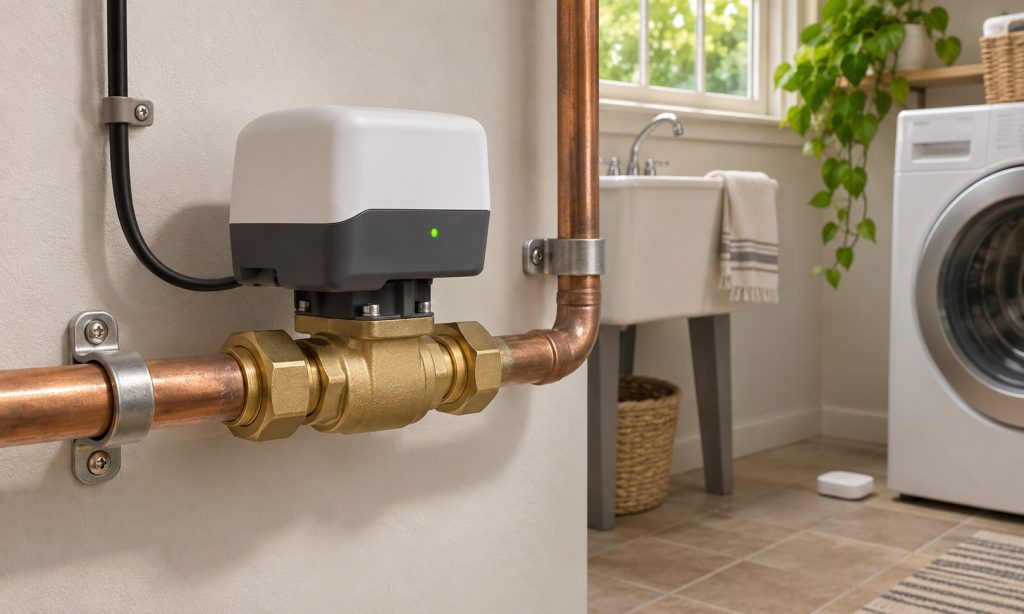
A supply hose can leak behind a washing machine while you are away. A toilet can quietly waste water all night. Neither problem necessarily leaves an obvious puddle where you will notice it.
So, how do smart water shutoff valves detect leaks? Depending on the system, they monitor water flow, analyze pressure, run pressure-loss tests, or receive signals from separate moisture sensors. Software evaluates those signals and may command a motorized valve to close. Different systems combine these methods differently. [1–4]
The important distinction is between detecting suspicious water use and knowing exactly where water is escaping. A smart valve can help limit damage, but it does not inspect every pipe or repair a failed connection. Understanding its methods makes alerts easier to interpret—and its limitations harder to overlook.
How Do Smart Water Shutoff Valves Detect Leaks During Everyday Use?
Many whole-house systems monitor the incoming supply and look for activity that differs from expected household use. They may consider flow rate, duration, total volume, pressure behavior, and learned routines. [1, 3]
A shower has a beginning and an end. A leaking supply connection may keep drawing water after everyone leaves. That continuing demand provides evidence of a possible problem, even when no floor sensor gets wet.
For an overview of the hardware and closing mechanism, see how automatic water shutoff valves work. Here, the focus is what tells the system something might be wrong.
Flow rate, duration, and volume
Flow rate describes how quickly water moves, commonly in gallons per minute. Duration tells the system how long that movement continues. Volume describes the total water used.
For illustration, a continuous flow of 2 gallons per minute uses 60 gallons in half an hour. That calculation does not establish a universal alarm threshold. It shows why time matters alongside speed.
A substantial flow might be a broken hose—or someone filling a bathtub. A smaller flow might be an intentional trickle or a leaking fixture. Software needs context, and thresholds vary by device and configuration. [3]
Learning household routines
Some systems build a picture of normal use over time. That can help distinguish familiar activity from unusual demand. Learning periods and the protections available during them vary. [1, 3]
Guests, irrigation, and long cleaning sessions can change your usual pattern. When an alert appears, identify the activity before dismissing it. Your plumbing does not consult the family calendar before becoming inconvenient.
How Do Smart Water Shutoff Valves Detect Leaks With Pressure?
Pressure-based detection includes two different ideas: analyzing changing pressure during normal use and checking pressure loss during an isolated test. They should not be treated as interchangeable features.
Pressure signatures during water use
Opening and closing fixtures creates pressure changes. Some systems analyze these patterns alongside flow information to help recognize water-use events and possible abnormalities. [4]
Think of this as recognizing a pattern rather than seeing through walls. A device may classify an event as toilet use without identifying the upstairs toilet with certainty. Fixture identification and locating a failed joint are different tasks.
Pressure-loss tests when fixtures are off
Some systems briefly close the supply valve during a quiet period and observe pressure in the isolated downstream plumbing. Unexpected pressure loss can indicate water leaving that section. [2]
This is useful for small leaks that may not appear on a live flow display. However, using a faucet or flushing during the test changes conditions. Depending on the system, the test may stop and run again later.
A failed check calls for investigation. A passing check means the device did not identify a problem under those test conditions; it is not a lifetime certificate for every pipe.
How Do Smart Water Shutoff Valves Detect Leaks With Separate Sensors?
Compatible moisture sensors provide another kind of evidence: water has reached a monitored spot. Some systems can link that signal to automatic shutoff, but pairing and configuration are required. A standalone alarm is not automatically a whole-house shutoff system. [5]
Typical monitoring locations include the area beneath a sink, near a washing machine, or beside a water heater. Follow the sensor’s placement instructions and think about where escaping water would actually travel.
A sensor on one side of a cabinet may miss water pooling on the other. Equally, a running toilet can send water straight down the drain while every nearby floor remains dry.
FYI, “leak detection” on a label does not tell you whether the device monitors pipes, detects puddles, or does both.
Comparing the Main Detection Methods
When asking how do smart water shutoff valves detect leaks, it helps to compare the evidence each method collects. No single signal answers every question.
| Method | What it evaluates | Main limitation |
|---|---|---|
| Flow monitoring | Rate, duration, and volume of water use | Legitimate use can resemble a leak |
| Pressure-pattern analysis | Pressure changes associated with plumbing activity | A pattern does not guarantee an exact location |
| Isolated pressure test | Pressure loss while the supply is temporarily closed | Requires suitable test conditions |
| Separate moisture sensor | Water reaching a monitored location | Cannot detect water that never reaches it |
These methods can complement each other, but available combinations depend on the system. Confirm the actual features and settings rather than assuming every smart valve includes all four. [1–5]
What Happens After a Possible Leak Is Detected?
Detection, notification, and shutoff are separate stages. A system first identifies a condition, then applies its configured response. That may mean an alert, an opportunity to respond, or automatic closure. [3]
Some alerts describe ongoing water use; others report a completed diagnostic test. Those messages do not necessarily carry the same urgency or trigger the same action.
Do not assume every small drip closes the valve immediately. Conversely, do not assume a serious alert is merely a notification. Review the response settings and confirm whether automatic shutoff is enabled.
Once the valve closes, it limits additional incoming water through that controlled line. It does not remove water already released. Pipes and connected fixtures can also contain water after the incoming supply stops.
My practical preference is a response plan everyone in the household understands: what an alert means, where the manual shutoff is, and who investigates before water is restored.
How Do Smart Water Shutoff Valves Detect Leaks That Are Very Small?
Very small leaks challenge systems because sensitivity differs between monitoring methods. A drip may be too small to appear on a particular live flow display yet still produce measurable pressure loss during a diagnostic check. [2]
Other systems document low-flow detection during normal operation. Do not transfer a sensitivity claim from one model or test mode to every smart valve. [3]
If a small-leak alert repeats, check accessible faucets, supply connections, toilets, and outdoor spigots. Note whether alerts happen continuously or only at certain times.
An intermittent toilet leak may appear different from a steady faucet drip. Give a plumber the alert history and test results if the source remains unclear. Avoid repeatedly changing sensitivity just to make the notifications disappear.
Why Can Normal Water Use Trigger an Alert?
Knowing how do smart water shutoff valves detect leaks also explains false alerts: the device measures activity, but it cannot directly know your intention.
Pool filling and irrigation can resemble unusually high demand. Manufacturer documentation identifies these as possible alert triggers, particularly while the system is learning. [3]
Before dismissing an alert, compare its timing with what actually happened. If the activity was intentional, follow the documented process for labeling it or adjusting settings. Use a temporary override only as instructed, then confirm normal protection has resumed.
My view is that a useful alert deserves a quick check, even when you suspect an innocent explanation. Permanently silencing protection turns a manageable nuisance into an unanswered question.
Installation Determines What the System Can Monitor
An inline monitor protects the plumbing covered by its installation position. Branches upstream of its measuring point are outside that downstream coverage.
Manufacturer instructions may specify placement relative to the manual shutoff, pressure regulator, and fixture branches. A pressure tank, pump, or other pressure-changing equipment can also matter for diagnostic testing. Have the installer follow the specific instructions for your plumbing arrangement. [6, 7]
Ask the installer to identify which outdoor faucets and irrigation lines are included. Check suitable pipe size, accessible power, and access for manual operation.
Fire-sprinkler supplies require particular care. A household leak-protection valve must not inadvertently disable fire protection; installation must follow the applicable system instructions and local requirements. [6]
This is why placement deserves as much attention as the app screen. A neat installation is useful only if it controls the intended water supply.
What Happens When Wi-Fi or Power Fails?
If you wonder how do smart water shutoff valves detect leaks during an outage, separate internet loss from electrical failure.
Without internet access, remote commands and notifications may be unavailable or unreliable. Whether detection and automatic closure continue locally depends on the system; confirm that behavior in its documentation. [8]
Power loss is a different issue. Do not assume the motorized valve automatically closes when electricity disappears. At least some systems explicitly remain open if they were open before the outage. [9]
Learn the documented manual procedure before you need it. Controls differ: some use a knob, while others require a tool. Ask the installer to demonstrate the method for your exact device. [9, 10]
What to Do When You Receive a Leak Alert
Treat an alert as evidence to investigate, not a diagnosis of a particular failed part.
- Read the message. Check whether it describes high flow, continuing use, or a pressure-test result.
- Match it to household activity. Ask whether anyone is showering, watering, or running an appliance.
- Inspect accessible areas. Look beneath sinks and around toilets, supply hoses, and the water heater.
- Stop an unexplained active leak. Use the appropriate shutoff if you can reach it safely. Avoid standing water near electrical equipment.
- Resolve the cause before restoring service. Contact a plumber if the source is hidden, the leak continues, or you cannot safely isolate it.
For suspected toilet leakage, the EPA describes a simple check: put a few drops of food coloring in the tank and wait 10 minutes without flushing. Color appearing in the bowl indicates leakage. Flush afterward to prevent staining. [11]
A blockage is a different problem. If the bowl is rising, follow the separate guidance on what to do if a toilet is clogged with wipes or an object. Closing the supply does not clear a drain or stop sewage backing up through it.
Frequently Asked Questions
These answers address the distinctions that matter when interpreting alerts and deciding what to check next.
How do smart water shutoff valves detect leaks behind walls?
They may identify abnormal water demand or pressure loss in the monitored supply plumbing without seeing the wet area. Detection does not necessarily reveal which wall contains the leak. Further investigation may be needed. [2, 4]
Can they detect a running toilet?
Flow monitoring may flag the continuing or unusual water use. A separate floor sensor generally needs water to reach its monitored spot, so it may miss a toilet leaking internally into the bowl. [3, 5]
Will every leak trigger immediate shutoff?
No. Response depends on detection thresholds, alert type, operating mode, and whether automatic shutoff is enabled. Some small leaks produce a warning for investigation rather than immediate closure. [1, 3]
Can they prevent every kind of water damage?
No. Controlling the incoming household supply does not stop rain intrusion or drain backups. Moisture sensors may warn when water reaches them, but closing a supply valve cannot control an unrelated water source.
Final Words
How do smart water shutoff valves detect leaks? They evaluate water-use and pressure signals, sometimes combined with separate moisture sensors, then apply the system’s configured response.
The useful next step is understanding your coverage: which plumbing is monitored, what triggers closure, and what still works during an outage. Keep alerts enabled, investigate repeated warnings, and learn manual shutoff. Smart monitoring works best alongside ordinary maintenance and a clear household response plan.
Research sources
Manufacturer support documentation is used to verify mechanisms, not to recommend products. Model-specific features are qualified in the article. Technical references are not retailer recommendations.
- Operating behavior and small-drip response
- Isolated pressure testing and tiny-leak detection
- Learning, flow alerts, response delays, and intended-use triggers
- Manufacturer technical FAQ: pressure signatures and flow analysis
- Moisture-sensor documentation and linked automatic shutoff
- Installation position and fire-suppression restrictions
- Pressure-test troubleshooting and installation considerations
- Connectivity symptoms and unavailable commands or alerts
- Power-loss behavior and manual control
- Device-specific manual valve operation
- EPA WaterSense: household leak checks