
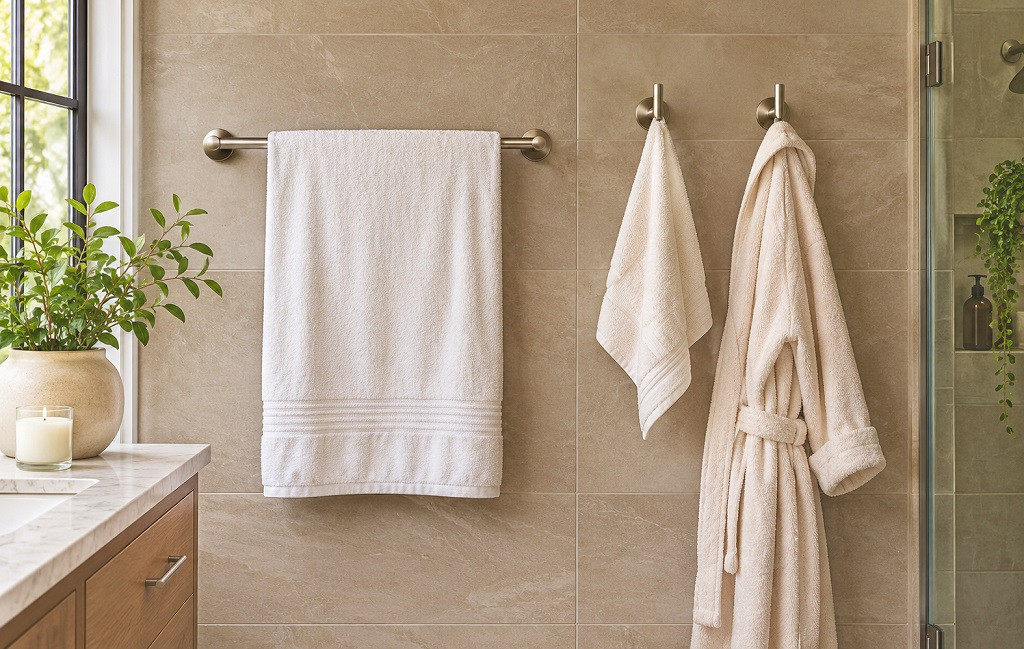
Choosing between towel hooks and towel bars may seem like a small bathroom decision. It affects how many towels you can store, how quickly they dry, how much wall space you use, and how tidy the room feels. The best choice depends on your bathroom layout and how your household uses towels.
In this guide to towel hooks vs towel bars, we’ll compare the strengths and drawbacks of each option, including what works best in compact bathrooms. We’ll also look at combination fixtures, placement, and installation considerations so you can choose a setup that fits your space.
Towel Hooks vs Towel Bars: What’s the Difference?
A towel bar is a horizontal rod mounted between two brackets. Towels hang across the rod, usually spread out to dry. Common lengths range from short hand-towel bars to longer bars designed for bath towels.
A towel hook is a single projection mounted on the wall or door. You hang a towel over it or by its sewn loop. Some hooks have two prongs, but they still hold towels in folds rather than spread across a rod.
In practical terms, towel hooks vs towel bars is a choice between compact hanging and more open drying. Hooks use less wall width and make it quick to hang a towel. Bars take up more linear space, but they give a towel more room to spread out.
Neither fixture is automatically better. A hook can be convenient for a frequently used hand towel, while a bar may suit a bath towel that needs to dry between uses.
Quick Comparison: Hooks vs Bars
| Feature | Towel hooks | Towel bars |
|---|---|---|
| Wall space | Takes up little horizontal space | Requires clear wall width |
| Towel position | Towel hangs folded or bunched | Towel can hang open |
| Drying | Depends on airflow and how the towel is folded | Often allows better airflow when the towel is spread out |
| Capacity | Usually one towel per hook | One or more towels, depending on bar length and spacing |
| Ease of use | Fast to hang; easy for children to reach | Towel needs to be placed over the bar |
| Best use | Hand towels, robes, compact spaces | Bath towels and towels that need room to dry |
| Cleaning | Simple fixture, though hooks can collect dust | More surface area to wipe; bar can collect dust underneath |
These are general comparisons. The exact result depends on the fixture design, towel size, room ventilation, and how neatly towels are hung.
Pros and Cons of Towel Hooks and Towel Bars
Advantages of towel hooks
Hooks work well where a full-length bar will not fit. You can line up several hooks along a narrow wall, mount them behind a door, or place one beside a sink for a hand towel. They are also straightforward for children and guests to use.
Hooks can make a small bathroom feel less crowded because they do not create a long horizontal line across the wall. They are useful for robes, washcloths, and towels that are changed frequently. If a towel has a hanging loop, a hook can be especially convenient.
The tradeoff is that towels often bunch up on a hook. A bunched towel may take longer to dry than one spread across a bar, particularly in a bathroom with limited ventilation. Hanging several damp towels close together can also make the area feel cluttered.
Advantages of towel bars
A bar gives a towel more room to hang open. That can help it dry between uses, especially when there is adequate airflow. Bars also keep towels neatly arranged and can accommodate larger bath towels that would otherwise drag or bunch on a hook.
A longer bar may hold more than one towel, but spacing matters. If towels overlap, they have less room to dry and the bar can look crowded. A double towel bar adds a second level, though it needs enough depth and clearance from nearby fixtures.
Bars require more wall width than hooks. They can also be less convenient if the bathroom layout makes it hard to reach or if the towel is too long for the available space.
Towel Hooks vs Towel Bars for Small Bathrooms
For towel hooks vs towel bars for small bathrooms, start by measuring the available wall space and identifying where towels can hang without touching a toilet, vanity, shower door, or cabinet. In a narrow bathroom, hooks may fit beside a vanity or on the back of a door when a standard bar would not.
Hooks are also useful when several people need a place to hang towels but there is little uninterrupted wall. A vertical row can make use of height instead of width. Leave enough space between hooks so towels do not crowd each other.
A short towel bar may still be the better choice if you have one open wall and want a bath towel to hang flatter. An 18-inch bar can fit in some places where a longer bar cannot, but always check the fixture’s actual dimensions and mounting requirements before buying.
A combination fixture can offer another option. A Towel Bar with Hooks provides a bar for towels that benefit from being spread out, plus hooks for washcloths, robes, or hand towels. It can save space, though it needs enough wall clearance and should not be overloaded.
Which Option Dries Towels Better?
A towel generally dries more easily when more of its surface is exposed to air. A bar makes it easier to spread a towel open. A hook usually leaves the towel folded over itself, which may slow drying if the fabric is thick or the room is humid.
That does not mean every bar dries towels well. If multiple towels are stacked together or the bathroom has poor ventilation, they may remain damp. A bar placed close to a shower or in a spot with little airflow may also offer limited benefit.
If towels smell musty between uses, look at the whole setup: how damp they are when hung, how closely they are packed, the room’s ventilation, and how often they are washed. Changing from a hook to a bar may help, but it cannot compensate for a consistently damp room.
How to Choose the Right Fixture
Consider the towel and the user
Think about what you will hang most often. Hand towels and robes work well on hooks. Large bath towels usually benefit from a bar with enough length to hang without bunching or touching the floor.
Consider who uses the bathroom, too. Hooks are easy to use for children, but a towel can fall off a smooth or shallow hook. A curved or double-prong design may hold it more securely. Bars are simple for most users, provided the towel is within comfortable reach.
Measure the space and check clearances
Measure the wall before choosing a fixture. Check the product’s full width and how far it projects from the wall. Make sure it will not interfere with a door swing, shower door, cabinet, or nearby accessory.
For multiple hooks, leave room for towels to hang separately. For a bar, confirm that the towel length suits the location. A towel that nearly brushes the toilet or vanity may be inconvenient, regardless of how attractive the fixture looks.
Match the fixture to your bathroom
Choose a finish and style that coordinate with the other bathroom hardware, such as the faucet, shower trim, and cabinet pulls. A matching finish can make different accessories feel intentional. You do not necessarily need to buy every item from the same product line, but check that the finishes look compatible in the room’s lighting.
Also consider the mounting surface. Tile, drywall, and wood require different approaches. Follow the fixture manufacturer’s instructions and use mounting hardware suited to the wall material. For example, Moen’s installation instructions distinguish between drywall and stud mounting and call for aligning the template before drilling.
Towel Ring vs Towel Bar: Where Does a Ring Fit?
A towel ring is another option, usually intended for a hand towel near a sink. In towel ring vs towel bar comparisons, the ring’s main advantage is its compact shape. It can fit beside a vanity where a bar would feel too long or interfere with another fixture.
A ring does not usually offer enough room for a full-size bath towel to hang open. It can also swing or shift as someone pulls a towel away, depending on the design and installation. Choose a ring for a hand towel or washcloth, and consider a bar or hook for larger towels.
Some bathrooms use all three: a ring by the sink, a bar for bath towels, and hooks for robes or extra towels. That arrangement works when each fixture has a clear purpose and the walls are not overloaded.
Common Mistakes to Avoid
- Choosing by appearance alone: A stylish fixture is frustrating if it is too short, too high, or difficult to reach.
- Packing towels together: Crowding hooks or a bar limits airflow and can make towels slower to dry.
- Ignoring wall construction: Use the correct mounting method for the wall and follow the manufacturer’s instructions.
- Putting fixtures where towels get in the way: Check door swings, shower doors, drawers, and walking paths before drilling.
- Assuming one fixture must do everything: A ring, bar, and hook can serve different purposes in the same bathroom.
- Using a decorative hook as a grab bar: Towel hooks and bars are designed for towels, not for supporting a person’s weight.
Frequently Asked Questions
Are towel hooks or towel bars better for a small bathroom?
Hooks usually fit better when wall space is limited or irregular. A short bar can be a better option if you have enough width and want a bath towel to hang more openly. Measure the space and consider what towel you will use there.
Do towels dry faster on hooks or bars?
A towel spread across a bar has more exposed surface area than one folded over a hook, so it may dry more quickly. Room ventilation, towel thickness, and spacing also matter.
How many towels can a towel bar hold?
It depends on the bar’s length and the size of the towels. Even if several towels fit, leave enough room between them to avoid bunching. Check the product’s instructions and weight limits.
Can I put towel hooks on the back of a bathroom door?
Often, yes, if the door and hook are suitable for that installation. Check the hook’s mounting directions and confirm that the towels will not catch on the door frame or interfere with the door closing.
Should I choose a towel bar with hooks?
A Towel Bar with Hooks can be useful when you want a place for both bath towels and smaller items without installing several separate fixtures. Check its width, projection, and mounting requirements to make sure it fits your wall.
Final Words
When comparing towel hooks vs towel bars, choose according to the towels you use, the space available, and how you want them to dry. Hooks are compact and convenient for hand towels, robes, and small bathrooms. Bars give larger towels room to hang more openly. A combination fixture can work when you need both options.
For many bathrooms, the most practical setup is a mix: a bar for bath towels, a hook for a robe or extra towel, and a ring near the sink for a hand towel. IMO, that is often more useful than asking one fixture to do every job. 🙂