
A washing machine hose can leak while you’re at work. A loose connection beneath the kitchen sink might drip unnoticed overnight. In either case, discovering the problem quickly matters—but stopping the incoming water matters just as much.
So, how do automatic water shutoff valves work? They receive a signal from a leak sensor or monitoring system, then close a valve to interrupt the water supply. Depending on the setup, they can protect one appliance or the plumbing downstream of your home’s main water connection. [1]
The important detail is what triggers that signal. Some systems react to water touching a sensor. Others evaluate water use or pressure changes. Understanding that difference helps you judge the protection, limitations, and upkeep involved.
How Do Automatic Water Shutoff Valves Work, Step by Step?
Think of the system as three cooperating parts: a detector, a controller, and a valve. An app may provide extra controls, but the physical valve stops the water.
1. A sensor or monitor notices a possible problem
A moisture sensor detects water at its location. A flow monitor measures water moving through a pipe. Depending on the equipment, the system may also use pressure measurements to investigate possible leaks. These are different detection methods, not interchangeable features. [13]
For example, imagine a dishwasher supply connection starts dripping. A correctly positioned floor sensor may detect the escaped water. A whole-house monitor instead looks for suspicious activity in the water supply.
2. The controller decides whether to act
In a basic sensor-operated setup, wet contacts can send a close command. More advanced monitoring systems compare activity against configured limits or learned household patterns. Some issue a warning before shutting off. [1, 3]
A long shower and a broken pipe are both water-use events. The controller must decide whether the event meets its shutdown criteria; it does not understand your intentions.
3. The actuator closes the valve
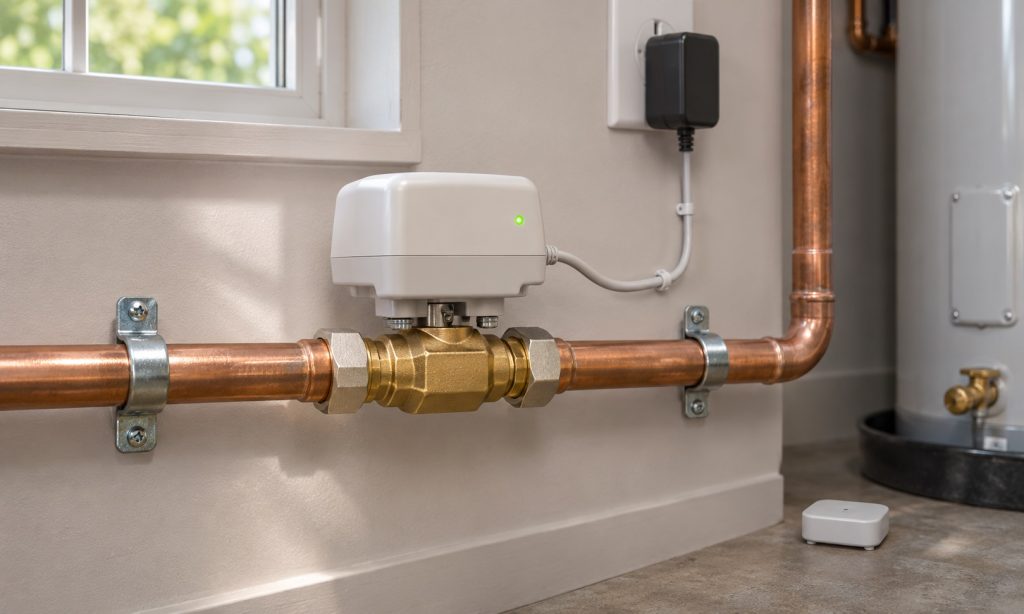
Many residential systems use a motorized ball valve. The actuator turns the internal ball so its opening no longer provides a passage for water. That blocks additional supply through the valve. [4]
Water already downstream may still escape. Closing the valve also does not repair the failed fitting or remove water from a cabinet. It limits the continuing supply while you address the problem.
How Do Automatic Water Shutoff Valves Work With Moisture Sensors?
Moisture-based systems use small sensors or sensing cables near likely leak locations. In a common design, water bridges conductive contacts, changing the electrical condition and triggering detection. [2]
The sensor communicates with the shutoff equipment through a supported connection. Some systems use a local radio signal, so the sensor-to-valve link does not require an internet connection. [4]
Useful locations can include beneath sinks, near washing machines, and beside water heaters. Placement deserves careful thought: a sensor cannot detect a puddle that never reaches it. [5]
Imagine a cabinet with two compartments separated by a raised divider. A leak in one compartment might not reach a sensor in the other. Looking at where water would actually collect is more useful than simply placing a sensor somewhere nearby.
FYI: A device that only sounds an alarm is not automatically a shutoff system. Confirm that detection is connected to equipment capable of closing the water supply. [13]
How Do Automatic Water Shutoff Valves Work With Flow Monitoring?
Flow-based systems watch water passing through the monitored line. They may assess the flow rate, total volume, and length of a water-use event. Some compare those measurements with learned household activity. [3, 6]
A running toilet illustrates the difference from moisture detection. Water may flow into the bowl and down the drain without wetting the bathroom floor. A floor sensor remains dry, while a suitable flow monitor may identify the unusual consumption.
These systems still need appropriate settings. Filling a large bathtub or watering the garden can produce an unusually long event without a plumbing failure. Manufacturer guidance documents legitimate activities that can trigger alerts and settings that influence the response. [6]
When asking how do automatic water shutoff valves work in a busy household, ask what information the controller uses. A timer, a fixed flow threshold, and an adaptive usage model can behave differently even when each controls a similar valve.
How Do Automatic Water Shutoff Valves Work With Pressure Tests?
Some systems perform a separate leak check by briefly closing the valve and monitoring pressure in the isolated household plumbing. A pressure drop can indicate water escaping, including through a small leak. [7]
This feature differs from continuous flow monitoring. It examines what happens during a controlled test rather than simply watching everyday consumption.
Normal water use can interrupt the test. For example, flushing a toilet during a pressure check changes conditions inside the plumbing. Some systems stop the test and restore normal flow when use resumes. [8]
Treat the result as evidence to investigate. A pressure-test alert does not identify the exact failed connection, and a passing result is not a permanent guarantee that every pipe is sound.
Whole-House and Appliance Shutoff Systems Compared
Coverage depends on where the valve is installed and which detectors control it. “Automatic” describes the action, not the size of the protected area. [1, 2]
| Setup | What it does | Main limitation |
|---|---|---|
| Appliance or branch shutoff | Interrupts supply to a particular appliance or branch | Other plumbing remains outside that valve’s coverage |
| Main-line valve with moisture sensors | Can shut the household supply when a connected sensor gets wet | Escaped water must reach a sensor |
| Main-line flow monitoring and shutoff | Watches water use through the monitored line and can close its valve | Legitimate unusual use may require configuration |
| Combined monitoring and moisture sensors | Uses more than one detection method | Components must be compatible and properly configured |
My preference is to start with a coverage question: “Which leak would this arrangement miss?” That is more revealing than counting features in an app.
Sketch the main supply, important branches, and likely leak locations before discussing placement with an installer. A simple drawing can expose gaps that a feature list will not.
What Happens When Wi-Fi or Power Fails?
These are separate questions. Losing internet access does not necessarily mean the valve has lost electricity.
Internet outages
Some powered systems retain local monitoring or emergency shutoff capability when disconnected from the internet. However, remote commands, live data, and notifications may be unavailable. The precise offline behavior depends on the system. [9]
If you are wondering how do automatic water shutoff valves work without Wi-Fi, check every connection involved. An onboard monitor and a remote wireless sensor may use different communication paths. Confirm which protections survive an outage instead of assuming all functions stay active.
Electrical outages
Power-loss behavior also varies. Some valves remain in their previous position. Other systems have specific restart behavior or optional backup power. A motorized valve should not be assumed to close automatically when electricity disappears. [5]
Ask the installer to demonstrate the documented manual override. Find out whether tools are required and keep the instructions accessible. [10] A household member should not need your unlocked phone to understand the emergency plan.
Why False Alarms Happen
Unexpected shutdowns can reflect legitimate water use that falls outside the system’s settings. Initial learning may also take time, and some behavior-based protections may be inactive during that period. [11]
Examples worth discussing during setup include irrigation, water-softener regeneration, visiting relatives, and unusually long filling tasks. Your plumbing monitor does not automatically know that the guest bathroom suddenly has four extra users.
Owner discussions include reports of shutdowns associated with gardening and softener cycles, as well as moisture sensors responding to spilled cleaning water. These are individual experiences, not measured failure rates. [12]
The practical lesson is to investigate before dismissing an alert. A suspected nuisance alarm may reveal a real problem.
Where supported, adjust settings using the instructions for your system. Temporary sleep modes or overrides can also suspend protection, so understand their consequences and confirm normal monitoring resumes. [6]
Installation Details That Affect Protection
Knowing how do automatic water shutoff valves work is only part of the job. The installation must suit the home’s plumbing and the equipment’s requirements.
Have a qualified plumber assess the installation location, valve size, connections, access, and local requirements. Manufacturer guidance commonly recommends professional installation for the valve itself. [5]
Ask these questions before work begins:
- Which fixtures and branches will be downstream of the valve?
- Can everyone reach the manual shutoff and override?
- Is the location suitable for the device’s environmental rating?
- Are power and required communication available there?
- How will the installer demonstrate a complete detection-and-closure test?
A domestic leak shutoff must not compromise a home fire sprinkler supply. Have the plumbing and fire-protection arrangement assessed before choosing the valve location. [2]
For wells, irrigation branches, and unusual plumbing layouts, ask the installer to confirm compatibility with the specific instructions. Avoid treating a generic installation diagram as approval for every home.
Maintenance and Responding to an Alert
Plan to check the system periodically using its manual. Manufacturer guidance recommends testing sensors to confirm placement, power, and communication with the valve. [4]
During a scheduled check, verify that sensors remain in their intended locations and respond using the prescribed test method. Confirm the actual valve operation, not just an app notification. Keep sensor batteries and any backup supply maintained as directed.
If an unexpected shutdown occurs, use this practical sequence:
- Read the alert and identify the indicated sensor or event.
- Check accessible plumbing for water or continuing leakage.
- Keep the supply isolated if a leak is confirmed or remains unexplained.
- Arrange repairs when the cause requires professional attention.
- Restore service according to the instructions after the problem is resolved, then watch for recurrence.
Do not repeatedly reopen the valve simply to silence the alert. That defeats the purpose of stopping the supply.
If water is near electrical equipment, stay clear and obtain qualified help. The shutoff valve addresses the water source; it does not make a wet electrical area safe.
Frequently Asked Questions
These answers cover the remaining practical limits homeowners should understand.
How do automatic water shutoff valves work when nobody is home?
A correctly configured system can detect a triggering condition and close its valve without waiting for someone to respond. Remote notifications may help you arrange repairs, but automatic operation depends on the system’s power, settings, and communication requirements. [1, 9]
Do automatic valves stop every kind of water damage?
No. A supply valve cannot stop rain entering through a roof or remove water already released. A floor sensor might detect water from several sources, but closing a domestic supply only interrupts water passing through that valve. [2]
How quickly will the water shut off?
There is no universal time. Detection, any warning period, communication, and valve movement all contribute. Ask about the total response for the relevant leak scenario, rather than assuming the motor’s closing time equals the time from leak onset. [4, 6]
Will every small leak trigger an automatic shutdown?
No. Detection thresholds, test conditions, and alert rules vary. A system may report a suspected small leak for investigation instead of immediately shutting down. Check its documentation for the distinction between an advisory alert and an automatic closure. [7, 8]
Final Words
The useful answer to “how do automatic water shutoff valves work” is straightforward: they detect a condition, evaluate it, and close a valve when the configured rules call for action.
The details determine the protection. Match detection to likely leak locations, understand coverage and outage behavior, and learn the reset procedure before an emergency. A carefully installed, tested system can help limit continuing water flow—but the damaged plumbing still needs repair.
Research Reference
Research checked November 8, 2026. Numbered markers above correspond to the sources below. Manufacturer materials establish specific mechanisms and limitations; they are not recommendations. Individual owner accounts inform usability examples only. No firsthand ownership or testing is claimed. No retailer sources were used.
- Original manufacturer explanation of sensor-triggered shutoff — local detection, valve closure, downstream protection, and unattended operation.
- EPA WaterSense: Know Your Flow and Curb Water Waste — detection categories, coverage, combined systems, limitations, and fire sprinkler considerations.
- Original technical explanation of usage-pattern analysis — learned behavior, alerts, and automatic shutoff.
- Original motorized-valve system installation manual — motorized ball valve, local radio sensors, and operating principles.
- Original installation, testing, and power-loss FAQ — professional installation, sensor placement/testing, and model-specific outage behavior.
- Original unusual-usage troubleshooting guidance — legitimate usage, thresholds, and sensitivity adjustments.
- Original small-leak test explanation — temporary isolation and pressure monitoring.
- Original plumbing-check documentation — pressure-loss checks and interruption by intentional water use.
- Original offline-operation documentation — limited local protection versus unavailable cloud functions.
- Original US valve specification and documentation page — manual override feature.
- Original learning-mode troubleshooting guidance — learning-stage limitations and occupancy effects.
- Public homeowner discussion — anecdotal experiences with softeners, irrigation, cleaning spills, and household controls; not technical authority or a representative reliability study.
EPA WaterSense overview of leak detection and flow monitoring — distinguishes moisture sensing and flow monitoring; detection alone should not be confused with valve actuation.