
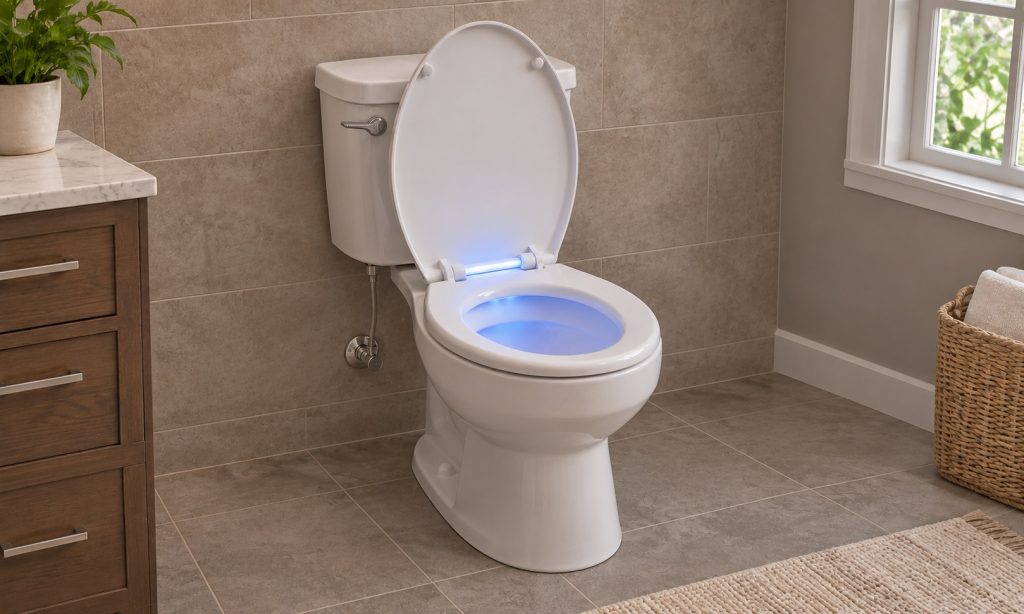
You want a softer glow for nighttime bathroom trips, but replacing a perfectly usable seat raises a practical question: do lighted toilet seats fit all toilets? No. A lighted seat must match your bowl’s shape, mounting arrangement, and available clearance. Some models also need a suitable electrical outlet.
Many standard toilets can accept a compatible illuminated replacement seat. However, “fits most toilets” does not mean every seat fits every bowl. The lighting feature tells you what the seat does, not whether it belongs on your toilet.
Before comparing brightness settings, grab a tape measure and identify your toilet model. A few measurements can prevent a seat that overhangs the bowl, rocks when used, or cannot open properly.
Why Don’t Lighted Toilet Seats Fit All Toilets?
A replacement seat has several points of contact with the toilet. Its hinges attach at the rear, while its bumpers support the seating ring on the rim. Those parts need to line up with the bowl and mounting surface.
Adding LEDs does not change those requirements. It can introduce another consideration: space for the lighting housing, batteries, or electrical connection.
When people ask, “Do lighted toilet seats fit all toilets?” the first distinction is the type of accessory involved:
- An illuminated replacement seat replaces the existing seat and needs compatible dimensions and hardware.
- A separate bowl light attaches independently and does not establish whether a replacement seat will fit.
- A heated or cleansing seat with lighting may have additional electrical, clearance, and plumbing requirements.
Start with the category you actually need. Otherwise, advice about a small lighting accessory can be mistaken for advice about a complete seat.
Round and Elongated Bowls Need Different Seats
The two familiar US residential bowl shapes are round-front and elongated. A standard round-front replacement seat and a standard elongated replacement seat are not interchangeable simply because their bolts line up.
A longer seat can project beyond a shorter bowl. A shorter seat can leave part of a longer bowl exposed. Either mismatch deserves attention before installation continues.
My view is simple: the lighting should be the finishing feature, after you have established a comfortable, supported fit. A glowing mismatch is still a mismatch.
Typical measurements to recognize
Measure bowl length from the midpoint between the mounting-hole centers to the outside front edge of the bowl.
| Measurement | Common reference | What to verify |
|---|---|---|
| Round bowl length | About 16½ inches | Compare your actual bowl with the seat’s fit diagram |
| Elongated bowl length | About 18½ inches | Confirm shape as well as length |
| Mounting-hole spacing | Commonly 5½ inches, center to center | Check the seat’s accepted spacing |
| Bowl width | Measure your toilet | Compare the outline and support locations |
| Rear clearance | Model-specific | Check room for the hinge housing and opening lid |
These are recognition guides, not guaranteed dimensions for every toilet. Also, a seat’s overall length may use different endpoints from a bowl-length measurement. Read the drawing before comparing numbers.
How to Measure Your Toilet Before Replacing the Seat
Rather than relying on “do lighted toilet seats fit all toilets” as a yes-or-no shopping shortcut, build a small record of your own toilet. Include measurements, photographs, and the model number when available.
Measure the bowl, not just the old lid
Raise the seat and lid so you can see the ceramic rim. Your existing lid may extend beyond the bowl or belong to an earlier, poorly matched replacement.
Record the front-to-back bowl measurement and the width at its widest point. Keep your measurement endpoints consistent with the replacement seat’s compatibility diagram.
Then photograph the bowl from directly above. This gives you a useful reference for comparing its outline with drawings. A photo alone cannot confirm fit, but it can help reveal an obvious shape mismatch.
Check the mounting holes and access
Measure between the centers of the two mounting holes. Next, inspect how the existing seat is secured.
Can you reach nuts beneath the bowl? Or does the toilet require a fastening method installed from above? Do not assume supplied hardware will work merely because the bolt spacing matches.
If access is unclear, take a photograph of the mounting area and ask the manufacturer which hardware is approved. This is especially useful before removing a functioning seat.
Record clearance behind the holes
Look at the space between the mounting holes and the tank or rear ceramic surface. Compare that space with the new seat’s installation drawing.
Ask whether the housing can sit flat, the lid can rise properly, and the battery compartment can be serviced. These are separate checks. A seat can look acceptable when closed yet interfere with the tank when raised.
Do Lighted Toilet Seats Fit All Toilets With Standard Bolt Spacing?
No. Standard bolt spacing addresses only the attachment points. It does not confirm the bowl outline, support, hinge clearance, or mounting access.
Imagine an elongated bowl with the expected hole spacing. A particular seat might still have a rear housing that conflicts with the toilet’s shape. Alternatively, the seat might align correctly but require hardware you cannot install from underneath.
Treat each requirement as a separate box to check. Avoid using one matching number as permission to ignore the rest.
FYI, adjustable hinges are useful for alignment within their stated range. They are not evidence that a seat can change from round to elongated or suit an unusual bowl.
One-Piece, Skirted, and Unusual Toilets Need Closer Checks
Do lighted toilet seats fit all toilets with a one-piece design? No universal answer applies beyond checking the particular toilet and seat together.
For a one-piece toilet, examine the ceramic behind the seat. For a skirted toilet, pay particular attention to mounting access. Do not assume either design automatically rules out an illuminated seat; equally, do not assume every fastening system is suitable.
Some designs require a particular seat outline or mounting arrangement. If your toilet looks distinctly different from standard round-front or elongated examples, identify the model before choosing a replacement.
Ask for confirmation that is specific enough to help
A useful support request includes:
- The toilet model and approximate age, if known.
- A top-down photo and a photo of the mounting area.
- Bowl length, width, and hole spacing.
- The exact replacement-seat model under consideration.
- Any existing attachment or restricted mounting access.
Ask whether that exact pairing is supported and whether additional approved hardware is required. Keep the reply with the installation instructions.
Battery Power and Plug-In Power Change the Installation
Do lighted toilet seats fit all toilets without an outlet nearby? Only models whose power arrangements suit that situation can be used as intended.
Battery-operated nightlight seats exist, so illumination alone does not necessarily require household wiring. Some use a timed lighting cycle instead of switching on whenever someone approaches. Check the actual controls before assuming there is a motion sensor.
A heated seat with lighting may require a nearby electrical receptacle and GFCI protection. Follow its current installation manual, including outlet placement and circuit requirements. Do not copy electrical specifications from a different seat.
If the specified receptacle is missing, have a qualified electrician assess the installation. Do not plan around an extension cord when the instructions prohibit one.
Mechanical fit and usable power are two different questions. Confirm both before removing packaging or starting installation.
Check Existing Attachments Before Adding a Lighted Seat
Do lighted toilet seats fit all toilets that already have an attachment beneath the seat? Compatibility cannot be assumed.
If you have an existing bidet attachment, raised-seat accessory, or other component, tell the seat manufacturer. Ask whether the combination is approved and whether it changes the mounting requirements.
Do not improvise with stacks of washers or unrelated spacers to force a fit. A solution that makes the bolts reach does not necessarily provide proper support.
For an accessibility setup, preserve the required stability and usability. An attractive lighting feature is not a reason to compromise an arrangement someone depends on.
Installing a Compatible Lighted Toilet Seat
Once compatibility is confirmed, use the instructions supplied for that exact model. A general installation overview helps you prepare, but it cannot replace the hardware diagram.
- Read the instructions first. Identify the parts, tools, and any power precautions before removing the old seat.
- Remove the existing seat carefully. If hardware is seized or access is difficult, stop before applying force that could damage the toilet.
- Prepare the mounting area. Clean it using a method suitable for the toilet and allow it to dry.
- Install the specified hardware. Follow the illustrated order for bolts, anchors, washers, and mounting plates.
- Align the seat. Keep it centered before completing the tightening procedure.
- Check operation. Confirm the seat and lid move freely and that the supplied supports contact the intended surfaces.
- Activate the light as directed. Follow the battery-orientation or electrical-connection instructions.
Do not compensate for rocking by repeatedly tightening hardware without investigating the cause. Recheck alignment, parts, and compatibility first.
What If the Seat Fits but the Light Does Not Work?
A dark LED does not automatically indicate a fit problem. Separate the mechanical checks from the lighting checks.
| What you notice | What to check next |
|---|---|
| Seat moves sideways | Alignment, fastening procedure, and correct hardware |
| Lid contacts the tank | Rear clearance and permitted hinge adjustment |
| Front edge looks mismatched | Bowl shape and the seat’s dimension drawing |
| Battery compartment is inaccessible | Service-clearance instructions and mounting position |
| Light stays off | Battery orientation, battery condition, and operating instructions |
| Light runs at an unexpected time | Timer settings or the model’s activation method |
Keep liquids away from battery compartments and electronic components as instructed. A toilet seat’s location does not mean its electronics can be soaked during cleaning.
If the housing is damaged or a prescribed check does not resolve the problem, contact the manufacturer. Avoid modifying the wiring or mounting parts.
A Final Compatibility Checklist
Before treating “do lighted toilet seats fit all toilets” as settled for your bathroom, confirm these details:
- The seat shape matches the actual bowl.
- Measurements match the manufacturer’s fit requirements.
- The correct mounting hardware can be installed.
- The housing and lid have adequate clearance.
- Batteries or electrical power can be supplied as specified.
- Existing attachments are approved for the combination.
- Controls, cleaning access, and battery access remain usable.
I would keep this checklist beside the technical drawing while comparing options. It is more useful than relying on a broad compatibility label or a photograph of a similar-looking toilet.
Frequently Asked Questions
These answers cover the remaining distinctions that can cause confusion when planning a replacement.
Do lighted toilet seats fit all toilets from the same manufacturer?
No. A shared manufacturer does not establish compatible dimensions. Check the toilet model against the specific seat’s requirements, especially when the bowl has an unusual outline.
Can I put an elongated lighted seat on a round toilet?
Do not treat an ordinary elongated seat as a replacement for a round-front seat. Matching mounting holes does not correct the outline or support mismatch. Use a seat explicitly approved for your bowl.
Do lighted toilet seats fit all toilets if the hinges adjust?
No. Adjustment has limits. Follow the stated range and confirm the rest of the fit. Moving a seat forward or backward cannot resolve every housing or bowl-shape conflict.
Does a lighted seat need a water connection?
Illumination by itself does not need a water supply. A seat that also provides a cleansing function has separate plumbing requirements. Read the feature list and installation manual together.
What if I cannot identify my toilet?
Record its measurements and take clear photographs of the bowl and mounting area. Ask the manufacturer or a plumbing professional for identification help before relying on an approximate match.
Final Words
Do lighted toilet seats fit all toilets? No, but checking compatibility is manageable. Match the bowl shape, measure carefully, inspect mounting access, and verify clearance and power requirements.
Choose based on the exact toilet and seat pairing. Once those details are confirmed, you can focus on the lighting controls and everyday convenience without discovering a fit problem halfway through installation.