
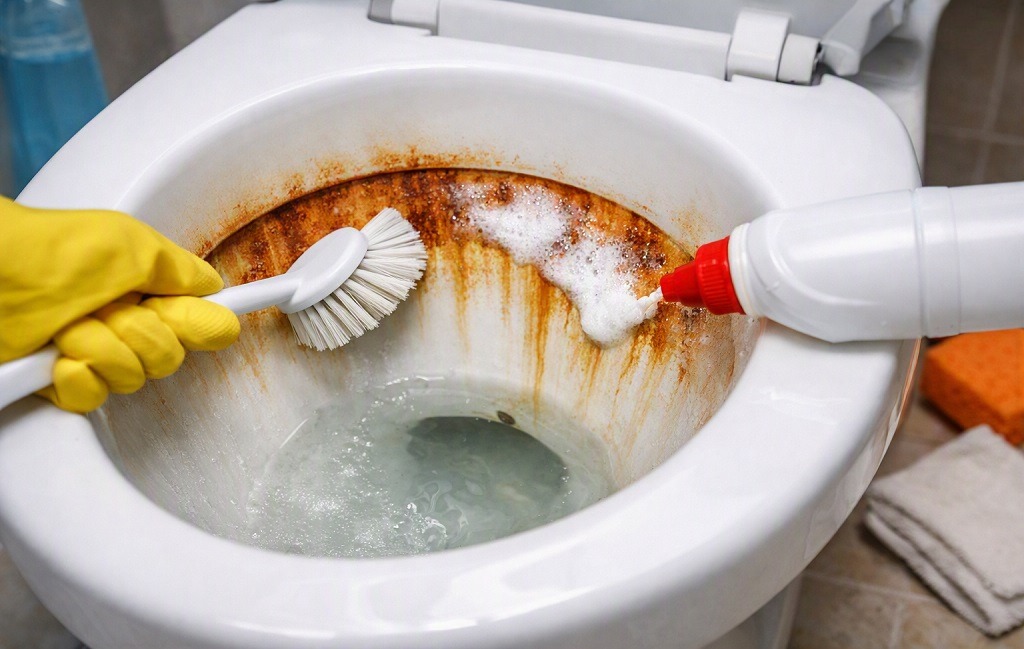
Rust stains can make an otherwise clean bathroom look neglected. Those orange, reddish-brown rings around the waterline are especially frustrating because regular toilet cleaner often seems to do almost nothing.
So, how to get rid of rust stains in toilet bowl without damaging the porcelain? The answer depends on how severe the buildup is. Light stains may respond to a mild acidic cleaning method, while stubborn rust and mineral deposits usually need a toilet-safe rust remover and some careful scrubbing.
The good news is that you do not necessarily need to replace the toilet or spend an entire Saturday attacking the bowl with a brush. The right approach can make a surprisingly big difference.
What Causes Rust Stains in a Toilet Bowl?
Most toilet rust stains are related to iron in the water. When iron-containing water repeatedly contacts the porcelain surface and reacts with oxygen, it can leave behind orange, reddish, or brown deposits.
This is particularly noticeable in homes with well water or water containing elevated iron levels. The EPA notes that iron and manganese deposits can produce rusty or brown staining on plumbing fixtures.
Hard water can make the situation even more annoying. Mineral deposits can accumulate on the porcelain and provide a rough surface where additional staining becomes easier to notice.
Common signs include:
- Orange rings around the toilet waterline
- Brown or reddish streaks
- Rust-colored deposits under the rim
- Staining that returns shortly after cleaning
- Rust buildup inside the toilet tank
- A stubborn ring that ordinary toilet cleaner will not remove
If you repeatedly clean the same area only to watch the stain return, the problem may not be the toilet bowl itself. The water entering your home may be contributing to the problem.
How to Get Rid of Rust Stains in Toilet Bowl
Before choosing a cleaning method, flush the toilet and remove as much loose debris as possible. Open a window or turn on the bathroom exhaust fan, put on appropriate gloves, and read the label of any commercial cleaner you plan to use.
Here is the basic process:
- Flush the toilet.
- Apply your chosen rust-removal method.
- Allow the product or solution to work according to its instructions.
- Scrub the stained area with a suitable toilet brush.
- For stubborn deposits, use a toilet-safe mechanical cleaning tool as directed.
- Flush thoroughly.
- Repeat only if the product instructions permit it.
For serious stains, patience usually works better than brute force. Scrubbing harder is not automatically the answer.
Method 1: Use a Toilet-Safe Rust Remover
For stubborn rust stains, a purpose-designed toilet rust remover is often the most straightforward option.
Look for a product specifically labeled for toilet bowls, porcelain, rust, or hard-water deposits. Some toilet cleaners are formulated specifically for rust and mineral buildup. For example, Clorox describes its bleach-free Lime & Rust product as an acidic cleaner intended for rust and hard-water stains.
The basic process is:
- Flush the toilet.
- Apply the cleaner according to the label.
- Make sure the stained area is adequately covered.
- Allow the cleaner to sit for the specified time.
- Scrub with a toilet brush if directed.
- Flush thoroughly.
Do not assume that leaving a cleaner on the porcelain for hours will produce better results. More is not always more when chemicals are involved.
Important: Never mix a rust remover with bleach, ammonia, vinegar, or another toilet cleaner unless the manufacturer specifically says the combination is safe. Mixing incompatible cleaning chemicals can produce hazardous fumes.
Method 2: How to Get Rid of Rust Stains in Toilet Bowl With Vinegar
Vinegar is one of the most commonly suggested household solutions for mineral deposits and light rust staining because it is acidic.
For a relatively light stain, you can try white distilled vinegar:
- Flush the toilet.
- Apply vinegar to the stained area.
- Allow it to remain in contact with the stain for a reasonable period.
- Scrub the area with a toilet brush.
- Flush the toilet.
- Repeat if necessary.
For stains around the waterline, keeping the affected area wet with vinegar can be more effective than simply pouring a small amount into the bowl and immediately flushing it away.
However, vinegar is not magic.
If the stain has been building for months or years, a mild household acid may not be strong enough to remove the entire deposit. In that situation, a purpose-designed toilet rust remover may be more appropriate.
Never use vinegar together with bleach or another chemical cleaner. Treat vinegar as a cleaning method on its own, not as an ingredient in a homemade chemical cocktail.
Method 3: How to Get Rid of Rust Stains in Toilet Bowl With Baking Soda
Baking soda is useful around the bathroom because it can help with light grime and odors, but it is important to set realistic expectations.
If you are searching for how to get rid of rust stains in toilet bowl with baking soda, understand that baking soda by itself is not usually the strongest choice for established rust.
You can use it as a mild abrasive:
- Flush the toilet.
- Sprinkle a small amount of baking soda over the affected area.
- Add enough water to create a light paste.
- Gently scrub with a suitable toilet brush.
- Flush and inspect the surface.
The advantage is simplicity. The limitation is that serious rust is a mineral deposit, and baking soda alone may not chemically dissolve a heavy rust ring.
IMO, this is one of those situations where the internet sometimes makes a simple household ingredient sound like a miracle product. It isn’t. 🙂
For a severe stain, use a cleaner specifically formulated for rust instead of repeatedly scrubbing with baking soda.
Method 4: Use a Toilet-Safe Pumice Tool for Stubborn Rust
A pumice cleaning tool can help with stubborn mineral deposits, but this method requires care.
Do not grab an ordinary abrasive stone and attack the porcelain. Use a product specifically intended for toilet or porcelain cleaning and follow its instructions.
The general technique is to keep the surface and tool appropriately wet and gently work on the deposit rather than aggressively scraping.
This method can be useful when a hard mineral or rust deposit has become physically bonded to the surface.
If you are unsure whether your toilet’s surface can tolerate the product, check the toilet manufacturer’s care instructions first.
Method 5: Address Hard Water and Iron Deposits
If rust stains return again and again, cleaning the bowl may only be treating the symptom.
The underlying water may contain enough iron to create recurring staining. In some homes, homeowners may need to investigate water filtration, iron-removal equipment, or other water-treatment options.
This is especially worth considering when you notice rust-colored staining on several plumbing fixtures—not just one toilet.
Which Rust-Removal Method Should You Use?
| Rust-Stain Problem | Suitable Approach | Difficulty |
|---|---|---|
| Light orange staining | Mild vinegar cleaning | Easy |
| Light surface buildup | Baking soda and gentle scrubbing | Easy |
| Moderate rust ring | Toilet-safe rust remover | Moderate |
| Heavy mineral/rust buildup | Purpose-designed cleaner and careful mechanical cleaning | Moderate |
| Rust that repeatedly returns | Investigate iron/hard-water source | Advanced |
The goal is not to use the strongest chemical available. The goal is to use the right method for the type and severity of the stain.
How to Remove a Rust Ring From a Toilet Bowl
A rust ring usually forms around the waterline where water repeatedly sits against the porcelain.
Start by flushing the toilet and cleaning away ordinary grime. Then apply a suitable rust-removal product according to its label.
Give the cleaner enough contact time to work, but do not exceed the manufacturer’s recommended time.
For a stubborn ring, gentle mechanical action may be necessary after the deposit has been loosened.
If you have a pumice tool specifically designed for toilet cleaning, use it carefully according to the manufacturer’s instructions.
One mistake I often see in DIY cleaning advice is treating every orange ring as exactly the same problem. Sometimes it is rust. Sometimes it is a combination of iron, hard-water minerals, and other deposits. Identifying the problem correctly saves time.
Does Bleach Remove Rust Stains From a Toilet?
Bleach is excellent for certain cleaning and disinfecting jobs, but it is not the ideal solution for mineral rust deposits.
Clorox specifically explains that hard-water stains and rust generally require acidic cleaners, while bleach is alkaline. Its guidance also warns that bleach should never be mixed with acids because hazardous fumes can form.
So if you have a rusty orange ring, reaching for bleach first may not solve the actual problem.
This distinction matters:
- Organic stains: bleach-based cleaners may be useful.
- Rust and mineral deposits: an appropriate acidic cleaner may be more suitable.
And please do not experiment by combining the two.
Why Do Rust Stains Keep Coming Back?
If you remove the stain and it returns a few days or weeks later, take that as a clue.
Possible causes include:
- Iron in the household water
- Hard water
- Rust or mineral buildup inside the toilet tank
- Old plumbing components
- Water-treatment problems
- Iron bacteria in some water systems
The EPA has documented that iron deposits can cause rusty or brown staining on plumbing fixtures.
If multiple sinks, tubs, toilets, or other fixtures are developing similar orange or brown stains, I would investigate the water supply rather than simply buying stronger toilet cleaner.
How to Prevent Rust Stains in Toilet Bowl
Knowing how to prevent rust stains in toilet bowl can save you much more time than repeatedly removing them.
Start with regular cleaning. Do not allow mineral deposits to build up for months before addressing them.
Here are some practical prevention steps:
1. Clean the Toilet Regularly
Regular cleaning prevents small deposits from becoming thick, stubborn buildup.
2. Pay Attention to the Toilet Tank
If you notice rust-colored material inside the tank, don’t ignore it. The material may eventually contribute to staining inside the bowl.
3. Investigate Your Water
If rust staining occurs throughout the house, consider having the water tested for iron and other relevant minerals.
4. Consider Water Treatment
Depending on your water source and test results, an appropriate filtration or iron-removal system may help address the underlying issue.
5. Don’t Rely on Bleach for Rust
Using more bleach will not necessarily solve a mineral-rust problem. Choose a cleaner designed for the type of deposit you’re trying to remove.
6. Clean Before the Stain Becomes Severe
A small orange stain is much easier to manage than a thick, established rust ring.
When Should You Call a Plumber?
Most ordinary toilet rust stains are a cleaning problem, not an emergency plumbing problem.
However, consider professional help when:
- Rust appears throughout your home’s plumbing fixtures.
- You notice persistent discoloration despite cleaning.
- The toilet tank contains significant rust or unusual buildup.
- You suspect corroded plumbing components.
- Your toilet has leaks or other plumbing symptoms.
- You have an older plumbing system and recurring corrosion concerns.
If the issue appears to originate with your water quality, a qualified water-treatment professional may be more appropriate than a plumber.
5 Frequently Asked Questions
Can vinegar remove rust stains from a toilet?
Vinegar may help with light rust or mineral deposits because it is acidic. However, severe or established rust stains may require a purpose-designed toilet rust remover.
Does baking soda remove rust from a toilet bowl?
Baking soda can provide mild abrasive cleaning and may help with light grime, but it is not usually powerful enough to dissolve heavy rust deposits by itself.
Does bleach get rid of toilet rust?
Bleach is not generally the preferred treatment for rust and hard-water deposits. Rust stains are mineral deposits, and suitable acidic cleaners are often more appropriate. Never mix bleach with acidic cleaners.
Why does my toilet keep getting orange stains?
Recurring orange stains may be associated with iron in the water, hard water, mineral deposits, or other water-quality issues. If several plumbing fixtures are affected, investigate the water supply.
What is the best way to prevent toilet rust stains?
Regular cleaning helps, but recurring rust often requires addressing the underlying cause. If iron-rich water is responsible, water testing and appropriate treatment may be more effective than repeatedly cleaning the toilet.
Final Words
Learning how to get rid of rust stains in toilet bowl is mostly about using the right method for the severity and cause of the stain.
For light buildup, vinegar or gentle cleaning may be worth trying. Baking soda can help with mild surface grime, but it should not be treated as a powerful rust dissolver. For stubborn deposits, a toilet-safe rust remover is generally a more practical choice. A suitable pumice cleaning tool can also help with hardened deposits when used carefully.
The bigger issue is recurring staining. If that orange ring keeps coming back no matter how thoroughly you clean it, look beyond the bowl. Iron-rich or hard water may be feeding the problem.
And remember the most important rule: never mix toilet cleaners or household chemicals unless the product manufacturer specifically says the combination is safe. A spotless toilet is nice. Accidentally creating hazardous fumes in the bathroom is considerably less nice.