
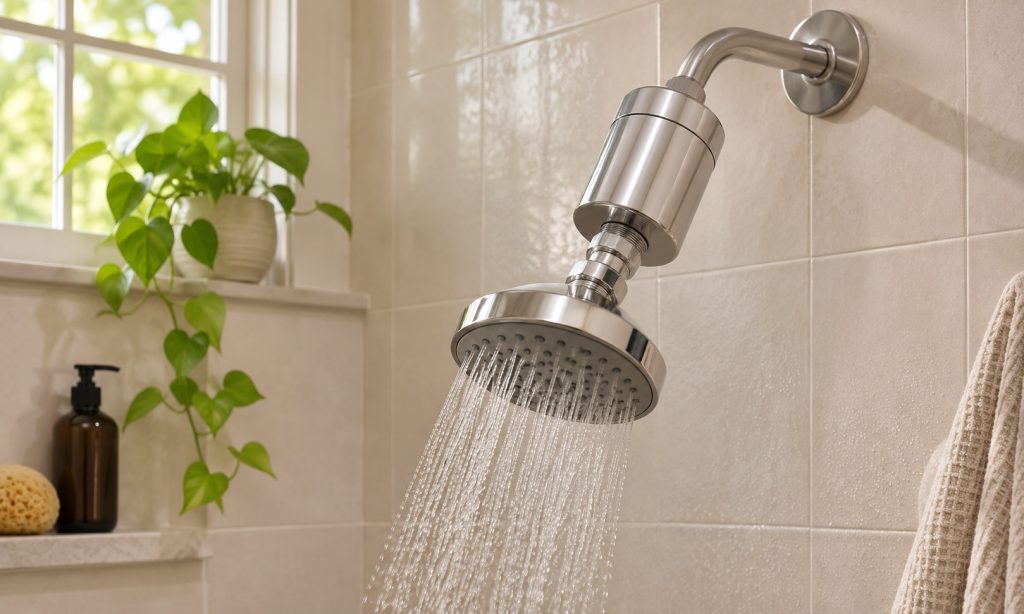
You’re looking at a shower filter that promises cleaner water, and one question keeps getting buried under the list of filtration stages: do shower filters remove fluoride? Usually, ordinary shower filters do not provide verified fluoride reduction. A cartridge designed for chlorine is not automatically equipped to remove dissolved fluoride.
That distinction matters before you spend money or assume your water needs treatment. Fluoride, chlorine, and the minerals responsible for hard water require different approaches. A shower that smells better does not prove that its fluoride level has changed.
The useful starting point is simple: identify what is in your water, decide what you want to change, and check evidence for that exact job. Here’s how to separate a meaningful treatment claim from an impressive-looking label.
Do Shower Filters Remove Fluoride or Mainly Chlorine?
For a typical shower attachment, chlorine reduction is the better-supported expectation. NSF explains that NSF/ANSI 177 certification covers reduction of free available chlorine, not fluoride. A filter carrying that certification has not thereby demonstrated fluoride removal. [1]
So, do shower filters remove fluoride when their packaging mentions “advanced filtration”? That wording alone cannot answer the question. Neither can a long list of materials or a diagram showing water passing through colorful layers.
A fluoride claim needs evidence specific to the complete system, its replacement cartridge, and its operating conditions. Until that evidence is available, treat fluoride reduction as unverified.
FYI, a stage count is a description of construction, not a scoreboard for water quality. Fifteen layers can still leave the substance you care about largely unaddressed.
Fluoride is different from chlorine and hardness
Fluoride can enter water naturally through contact with rocks and soil. Some communities also adjust fluoride levels to help prevent cavities. Your water provider is the best starting point for information about your supply. [2]
Chlorine serves a different purpose: disinfection. Hardness refers mainly to calcium and magnesium. Treating one does not establish that the others have changed.
If your actual concern is mineral buildup, understanding how to choose a shower filter for hard water helps you distinguish chlorine filtration from genuine softening. Keep that decision separate from fluoride treatment.
Why Ordinary Shower Cartridges Are a Poor Basis for Fluoride Claims
Fluoride is dissolved in water. Catching visible debris is therefore a different task from reducing fluoride ions. A fine screen or sediment layer cannot be assumed to perform both jobs.
Conventional activated carbon is also not a dependable fluoride-removal method. Specialized materials and engineered treatment processes may behave differently, but the familiar word “carbon” is insufficient evidence. Health Canada’s technical review identifies approaches such as activated alumina and reverse osmosis for fluoride reduction. [3]
Media names do not establish complete-system performance
A label might list carbon, copper-zinc media, calcium sulfite, vitamin C, or mineral beads. The practical question remains: what does the finished cartridge demonstrably reduce?
Ask for results that explicitly name fluoride. Chlorine data cannot substitute for them, and testing a small sample of media does not necessarily establish the performance of the assembled filter.
This is why asking “do shower filters remove fluoride?” requires more than identifying what is inside the housing. You need to know how the whole device performs while water actually passes through it.
Flow, temperature, and capacity deserve attention
A shower operates continuously rather than treating a glass of water at a time. Any claimed performance should therefore be demonstrated at a suitable flow rate and temperature.
As a simple example, an eight-minute shower flowing at 2 gallons per minute uses 16 gallons. Two such showers use 32 gallons. These are illustrative figures, but they show why cartridge capacity matters.
Ask whether the reported reduction applies only to a new cartridge or continues through its rated service life. An excellent starting result is less useful if performance later drops without an obvious warning.
What Certification Actually Tells You
The most useful label identifies a standard, the certified model, and a named reduction claim. Those details should agree with the certifier’s listing.
NSF/ANSI 58 covers reverse-osmosis drinking-water systems, and NSF’s directory includes systems with fluoride-reduction claims. However, the standard number alone is not a promise that every listed contaminant is reduced. Check fluoride specifically. [4]
When comparing evidence, ask:
- Does the listing match the exact model and cartridge?
- Is fluoride reduction explicitly included?
- What flow, pressure, temperature, and capacity limits apply?
- Does the documentation give incoming and treated fluoride concentrations?
- Is this ongoing certification or a report on one submitted sample?
A report can provide useful evidence without being certification. Keep the distinction clear when judging the claim.
Do shower filters remove fluoride just because they display a certification logo? No. Read what the certification covers before assigning it a broader meaning.
Is Fluoride in Shower Water the Main Exposure Concern?
For fluoride, the amount swallowed through drinking water is more relevant to routine household decisions than normal skin contact during bathing. CDC states that fluoride is not absorbed through the skin and that water with excess fluoride can still be used for cleaning and bathing. [2]
That does not mean every type of contaminated water is suitable for showering. Follow local instructions when an advisory concerns another substance or prohibits water use.
If fluoride testing identifies a problem, focus your initial discussion with your health department on drinking and cooking water. Do not assume that replacing the showerhead resolves exposure elsewhere in the house.
Avoid diagnosing water problems from your skin or hair
Dry skin, an itchy scalp, or a change in hair texture cannot identify your water’s fluoride concentration. Those experiences also cannot demonstrate that a filter removed fluoride.
Persistent symptoms deserve appropriate medical advice. Water-treatment decisions should rest on water information and verified performance, rather than a guess about which dissolved substance is responsible.
What Treatments Can Reduce Fluoride?
Several treatment approaches can reduce fluoride, but that does not make them interchangeable with a screw-on shower cartridge. Match the method to the volume of water and the location you need to treat.
| Treatment approach | Fluoride relevance | Practical consideration |
|---|---|---|
| Ordinary shower cartridge | Do not assume verified reduction | Check its actual certified claims |
| Reverse osmosis | Can reduce fluoride | Verify the specific system’s fluoride claim |
| Activated alumina | Can adsorb fluoride | Performance depends on design and water chemistry |
| Distillation | Can remove fluoride | Produces treated water in batches and requires energy |
| Conventional hardness softener | Hardness reduction does not establish fluoride reduction | Require separate fluoride evidence |
Reverse osmosis
Reverse osmosis uses a membrane to separate treated water from a more concentrated waste stream. CDC notes that these systems may reduce fluoride and recommends checking the system’s specific claims. [5]
For a household concerned about water consumed in drinks and food, evaluating treatment at a kitchen tap is a sensible starting point. Ask about production capacity, replacement parts, maintenance, and wastewater requirements.
Do not connect a drinking-water unit to a hot shower line unless the equipment is expressly designed for that application. A treatment technology’s capability does not make every installation appropriate.
Activated alumina
Activated alumina is an adsorptive medium used for fluoride treatment. EPA identifies conventional activated alumina as an option for fluoride removal. Its treatment guidance also emphasizes that adsorptive media need appropriate operating conditions and eventual replacement or regeneration. [6]
Health Canada describes the importance of factors including pH and contact time. [3] A cartridge merely containing some activated alumina therefore needs complete-system performance evidence, not assumptions based on the ingredient.
Before selecting this approach, ask how your water chemistry affects capacity and how treated water will be checked over time.
Distillation
Distillation boils water and collects the condensed vapor separately. Minnesota’s health department lists fluoride among the substances this process can remove. [7]
This is a drinking-water treatment option, not a practical substitute for a continuous shower supply. Energy use and production time are part of the decision.
Simply boiling water in an open pot is not the same process: the treated condensate must be collected separately. Do not confuse a household kettle with a distillation system.
How to Check Your Water Before Choosing Treatment
If you keep asking “do shower filters remove fluoride?” without knowing your water’s fluoride level, pause the equipment comparison. Start with information about the water itself.
For public water, ask the utility for its current fluoride results and review its water-quality report. For a private well, arrange laboratory analysis; your local public-health department can help identify an appropriate testing route. [2]
Then write down three things: the measured concentration, the reason you want treatment, and which taps need treated water. That short list makes conversations with installers far more productive.
Request fluoride-specific testing
Do not use a chlorine test, hardness strip, or general dissolved-solids reading as a substitute for a fluoride result. Each answers a different question.
When assessing treatment, ask the laboratory how to collect paired untreated and treated samples. Follow its instructions for containers, timing, handling, and delivery.
If the equipment makes a fluoride claim, plan follow-up testing rather than relying indefinitely on the first result. Ask the supplier how it expects you to confirm continued performance near the cartridge’s replacement point.
Interpret percentages alongside actual results
Suppose a report shows a reduction from 4 mg/L to 1 mg/L. That is a 75% reduction. A second report showing 1 mg/L to 0.25 mg/L also describes 75%, despite a different final concentration.
This hypothetical comparison illustrates why both numbers matter. Do not judge suitability from a percentage alone; compare the treated concentration with the guidance relevant to your household.
What Reader Experiences Can—and Cannot—Tell You
Imagine a homeowner installs a filter and reports that the shower smells less chlorinated. That observation may matter to their satisfaction. It still does not answer “do shower filters remove fluoride?”
Likewise, an account of smoother-feeling hair is not a fluoride measurement. It may be sincere without establishing the cause of the change.
I would use owner feedback to investigate practical questions: Does the housing leak? Is cartridge replacement awkward? Does the added length make the showerhead inconvenient? I would reserve chemical-removal judgments for suitable testing.
IMO, an accessible performance sheet deserves more attention than a dramatic before-and-after photograph.
Frequently Asked Questions
These answers address the distinctions most likely to affect your next step.
Do shower filters remove fluoride if they have multiple stages?
Not necessarily. Stage count does not establish fluoride performance. Look for a claim supported by testing of the complete filter under its intended operating conditions.
Do shower filters remove fluoride and chlorine together?
Do not assume they do. A chlorine-reduction claim only establishes that specific function. Fluoride requires its own evidence, even when both substances appear in the same marketing description.
Does NSF/ANSI 177 certification include fluoride?
No. NSF describes this shower-filter standard as covering free available chlorine reduction. Fluoride removal is not established by that certification. [1]
Will a water softener solve a fluoride problem?
A conventional softener targets hardness through cation exchange. That function should not be treated as proof of fluoride reduction. Specialized treatment configurations require their own documented claims. [1]
Is whole-house fluoride treatment always necessary?
No. Start by identifying the concentration and the intended treatment goal. A point-of-use system may suit drinking and cooking needs; whole-home equipment requires a separate assessment of capacity, installation, and maintenance. [8]
Can I confirm fluoride removal by checking the water’s smell?
No. Smell is not a fluoride test. Use a fluoride-specific laboratory result when you need to establish whether treatment has changed the concentration.
Final Words
So, do shower filters remove fluoride? Ordinary shower filters should not be relied on for that purpose without specific, credible evidence. Chlorine certification, extra stages, and pleasant-feeling water do not establish fluoride reduction.
Start with your water results, then match treatment to the actual concern. If fluoride reduction is warranted, evaluate a verified treatment method and confirm its performance over time. That gives you a useful answer—and a much better basis for spending money than the promises on a filter box.
Reference:
- NSF: Standards for Water Treatment Systems
- CDC: Community Water Fluoridation Frequently Asked Questions
- Health Canada: Fluoride—Technical Considerations and Treatment
- NSF: Certified Systems With Fluoride Reduction Claims
- CDC: About Home Water Treatment Systems
- EPA: Overview of Drinking Water Treatment Technologies
- Minnesota Department of Health: Home Water Treatment
- CDC: About Choosing Home Water Filters