
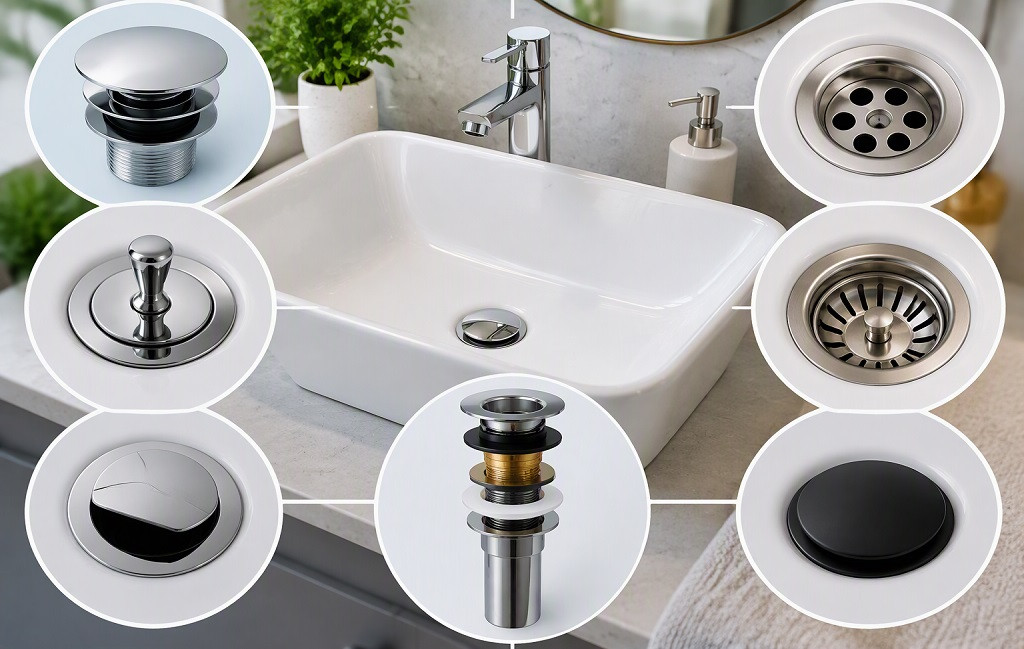
Choosing a bathroom sink drain may seem like one of those small remodeling decisions that should take five minutes. Then you start comparing pop-up mechanisms, grid drains, overflow openings, finishes, and drain sizes—and suddenly the “simple” drain is getting more attention than the sink itself.
Understanding bathroom sink drain types makes the decision much easier. Different drains are designed for different sink configurations, operating preferences, and installation requirements. Some allow you to close the drain with a lever, some use a push mechanism, and others are designed primarily to keep debris out while allowing water to flow freely.
This guide explains the major bathroom sink drain types, how they work, where they are commonly used, and what to check before purchasing a replacement or new drain assembly.
What Is a Bathroom Sink Drain?
A bathroom sink drain is the assembly that allows wastewater to leave the basin and enter the drainpipe beneath the sink. A typical bathroom sink drain assembly can include a drain flange, stopper or strainer, gasket, retaining hardware, and connecting components.
The visible portion is only part of the system. Underneath the sink, the drain assembly connects to the trap and the home’s drainage system.
The important point is that not every drain fits every sink.
The sink’s drain-hole size, overflow configuration, drain design, and the type of stopper mechanism all matter. This is why understanding bathroom sink drain types before purchasing a replacement can save you from ordering a product that looks perfect online but doesn’t fit your sink.
Main Bathroom Sink Drain Types
There are several common bathroom sink drain types used in residential bathrooms. Some are categorized by how the stopper operates, while others are classified by their physical design.
1. Pop-Up Bathroom Sink Drain
The pop up bathroom sink drain is one of the most common choices for traditional bathroom sinks.
It typically uses a lift rod located behind the faucet. When you pull the rod upward, the stopper closes. Push it down, and the stopper opens.
A pop-up system is convenient because you can operate the drain without putting your hand into the basin. It also gives the sink a familiar, traditional appearance.
The disadvantage is that the linkage underneath the sink contains several moving parts. Over time, those components can loosen, corrode, or require adjustment.
For a traditional bathroom vanity, however, a pop-up drain remains a practical choice.
2. Push-Button or Push-Down Drain
A push button bathroom sink drain operates directly from the stopper.
Press it once to close the drain and press it again to open it. There is no lift rod or complicated linkage extending behind the faucet.
This design provides a cleaner appearance and is especially popular in modern bathroom renovations.
Maintenance is also relatively straightforward because the stopper can often be removed for cleaning. If you regularly deal with hair, soap residue, or mineral buildup, having easy access to the stopper can be a significant advantage.
3. Grid Drain
A grid drain looks different from a conventional stopper because it contains a perforated or cross-patterned surface rather than a solid stopper that completely closes the drain.
The primary purpose is to allow water to pass through while helping prevent larger debris from entering the drainage system.
Grid drains are particularly common with vessel sinks and contemporary bathroom designs.
One limitation is that a traditional grid drain generally does not provide the same convenient basin-sealing function as a pop-up stopper. If you frequently fill your bathroom sink with water, this distinction matters.
4. Lift-Rod Drain
A lift-rod drain is closely related to the traditional pop-up design.
The drain is controlled by a rod positioned behind the faucet. Pulling or pushing the rod moves the stopper through a linkage beneath the sink.
This is a proven design that has been used in residential bathrooms for decades.
Its biggest advantage is familiarity. Most plumbers and homeowners understand how the mechanism works, and replacement components are widely available.
Its biggest drawback is that the mechanism has more moving parts than a simple push-button design.
5. Vessel Sink Drain
Vessel sinks sit above the countertop rather than being installed below or flush with it. Because of that configuration, they often require a drain designed specifically for vessel-sink applications.
Some vessel sinks have overflow openings, while others do not. That distinction is critical.
A vessel sink drain may be a pop-up, grid-style, or other configuration depending on the sink and manufacturer’s design.
Don’t assume that a drain advertised as a “vessel sink drain” will automatically fit every vessel sink. Always check the drain-hole dimensions and overflow requirements before buying.
6. Bathroom Sink Drain With Overflow
A bathroom sink drain with overflow is designed to work with a sink that has an overflow opening.
The overflow is the small opening, usually near the upper portion of the basin, that provides an additional path for water if the basin becomes too full.
A drain designed for an overflow sink typically includes openings that allow water from the overflow channel to enter the drain assembly.
If your sink has an overflow, make sure the replacement drain is compatible with it.
7. Bathroom Sink Drain Without Overflow
Some modern sinks do not have an overflow opening. These sinks require a drain designed for a no-overflow configuration.
Using the wrong type can create compatibility problems and may prevent the drain from functioning as intended.
This is one of the most important distinctions among bathroom sink drain types because the difference may not be obvious from a product photograph.
8. Universal Bathroom Sink Drain
A universal bathroom sink drain is designed to fit a broad range of sinks rather than one specific sink model.
However, “universal” does not mean “fits absolutely everything.”
You still need to check the drain-hole diameter, sink thickness, overflow configuration, thread dimensions, and other specifications.
Universal drains are convenient for replacement projects, but always compare the manufacturer’s measurements with your existing sink before purchasing.
Bathroom Sink Drain Types Compared
| Drain Type | How It Works | Best For | Main Advantage | Potential Drawback |
|---|---|---|---|---|
| Pop-Up | Lift rod controls stopper | Traditional sinks | Familiar operation | More moving parts |
| Push-Button | Press stopper to open/close | Modern bathrooms | Clean appearance | Mechanism may need replacement |
| Grid Drain | Open grid allows water flow | Vessel/contemporary sinks | Simple design | Usually cannot seal basin |
| Lift-Rod | Rod operates stopper linkage | Traditional vanities | Proven design | Linkage can loosen |
| Vessel Drain | Designed for vessel sinks | Above-counter sinks | Proper vessel compatibility | Must match sink configuration |
| With Overflow | Works with overflow channel | Sinks with overflow | Proper overflow compatibility | Not suitable for no-overflow sinks |
| Without Overflow | Designed for solid/no-overflow sinks | Modern sinks without overflow | Correct fit for no-overflow basins | Not intended for overflow sinks |
How to Choose the Right Bathroom Sink Drain
Choosing among bathroom sink drain types becomes easier when you work through a few basic questions.
Check Your Sink Type
Start with the sink itself.
Is it a traditional drop-in bathroom sink, undermount sink, pedestal sink, or vessel sink?
The sink design can determine which drain assemblies are appropriate.
Check for an Overflow Opening
Look inside the basin near the top.
If you see an overflow opening, you generally need a compatible drain designed for an overflow configuration.
If there is no overflow opening, look for a drain specifically designed for a no-overflow sink.
This is one of the easiest mistakes to avoid—and one of the most frustrating mistakes to discover after installation.
Measure the Drain Opening
Don’t rely solely on the product title.
Measure the existing drain opening and compare it with the manufacturer’s specifications.
Bathroom sink drain sizes can vary, and even a small dimensional difference can prevent a proper installation.
If you are replacing an existing drain, measuring the old assembly before ordering is a much safer approach than guessing.
Consider the Operating Mechanism
Think about how you prefer to use the sink.
A pop-up drain is convenient if you want a traditional lever-operated stopper. A push-button drain offers simpler operation and a more modern appearance.
If you rarely need to fill the basin, a grid drain may also make sense.
Consider the Finish
The drain is relatively small, but it sits directly next to the faucet. A mismatched finish can make an otherwise attractive bathroom look slightly… confused. 🙂
Chrome, brushed nickel, matte black, and other finishes are widely available.
Matching the drain to the faucet is usually the easiest way to create a coordinated appearance.
Bathroom Sink Drain Size and Compatibility
Size is one of the most important considerations when comparing bathroom sink drain types.
The drain-hole diameter is only one measurement. You may also need to consider the thickness of the sink, drain-body dimensions, gasket placement, and connection to the drainpipe.
Before purchasing a replacement, check:
Drain-hole diameter
Sink thickness
Overflow configuration
Drain-body dimensions
Thread size
Stopper design
Manufacturer’s compatibility information
If you’re completing a larger repair, a Bathroom Sink Drain Pipe Kit may contain several of the components required to connect or replace portions of the drain system.
However, a drain pipe kit and a drain assembly are not necessarily the same thing. Read the product description carefully before ordering.
Bathroom Sink Drain Replacement: When Should You Replace It?
A Bathroom sink drain replacement may be appropriate when the existing assembly is badly corroded, leaking, difficult to operate, or no longer seals properly.
You don’t necessarily need to replace the entire assembly every time something goes wrong.
For example, a damaged stopper may be replaceable separately. In other cases, corrosion around the flange or drain body makes replacing the complete assembly more practical.
When replacing the drain, remove the old components carefully and clean the sink’s drain opening before installing the new assembly.
A new gasket installed against a dirty or damaged surface can still leak. That’s a small detail, but it matters.
Common Mistakes When Choosing Bathroom Sink Drains
Buying Based Only on Appearance
A drain can look perfect in an online photograph and still be incompatible with your sink.
Always check measurements.
Ignoring the Overflow
This is particularly common with online purchases.
If your sink has an overflow, verify that the drain assembly supports it. If your sink doesn’t have one, select a compatible no-overflow drain.
Assuming “Universal” Means Universal
A universal bathroom sink drain is intended to accommodate multiple configurations, but manufacturers still specify limits.
Check the specifications before ordering.
Forgetting About Maintenance
A drain with a complicated mechanism may look attractive, but consider how easy it will be to clean and repair.
If your bathroom regularly experiences hair or soap buildup, easy stopper removal can be valuable.
Frequently Asked Questions
1. What are the most common bathroom sink drain types?
The most common bathroom sink drain types include pop-up drains, push-button drains, grid drains, lift-rod drains, vessel sink drains, and drains designed specifically for sinks with or without overflow openings.
2. Are bathroom sink drains universal?
Not necessarily. A universal bathroom sink drain may fit many sinks, but compatibility still depends on measurements, sink configuration, overflow design, and the manufacturer’s specifications.
3. What is the difference between a pop-up and grid drain?
A pop-up drain has a movable stopper that can close the basin. A grid drain has an open, perforated surface that allows water to flow continuously. A pop-up is generally better when you want to fill the basin, while a grid drain emphasizes simple drainage.
4. Do I need a drain with or without overflow?
Look at your sink. If it has an overflow opening, choose a compatible drain designed for an overflow configuration. If there is no overflow, choose a no-overflow drain. Always verify the manufacturer’s specifications.
5. How do I know what size bathroom sink drain I need?
Measure the existing drain opening and compare it with the replacement manufacturer’s specifications. Also check sink thickness, overflow configuration, and the dimensions of the drain assembly before purchasing.
Final Words
Understanding bathroom sink drain types makes bathroom fixture shopping much less confusing. The right choice depends on more than appearance. Your sink’s configuration, drain-hole dimensions, overflow design, preferred stopper mechanism, finish, and maintenance requirements all matter.
For a traditional bathroom vanity, a pop-up or lift-rod drain can be a dependable choice. A push button bathroom sink drain provides a cleaner, more modern operating style, while a grid drain may work particularly well for applications where you don’t need to seal the basin.
If you’re working with a vessel sink, pay close attention to compatibility. And if you’re considering a universal bathroom sink drain, remember that “universal” is a helpful marketing term—not a guarantee that every sink in America will accept the same piece.
Take a few measurements before ordering, confirm the overflow configuration, and compare the manufacturer’s specifications. Those few minutes can prevent a surprisingly annoying return shipment later. :/